Membrane Biology
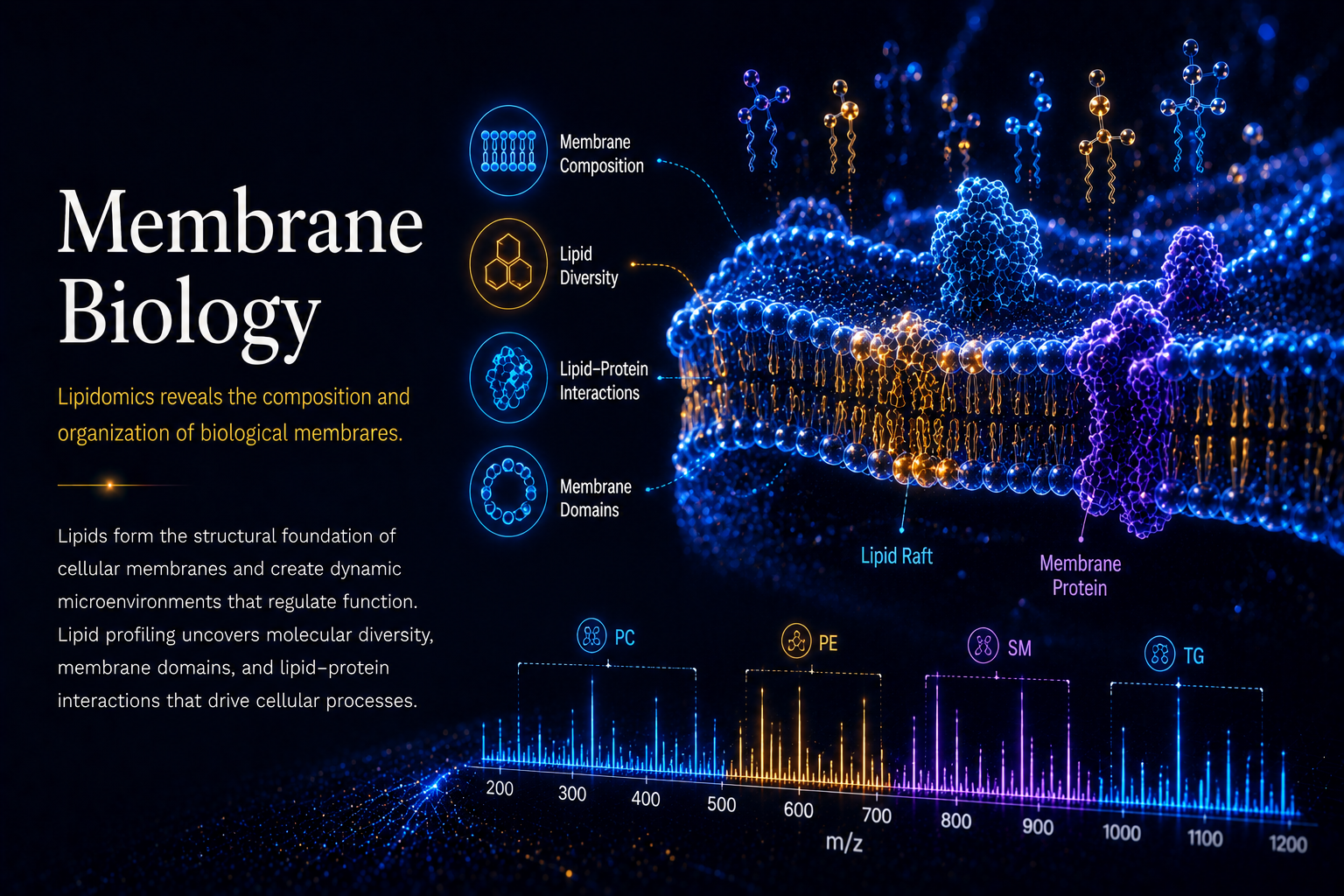
Membrane biology lipidomics studies how lipid composition, membrane organization, lipid–protein interactions, and membrane remodeling regulate cellular structure, signaling, metabolism, and disease.
Research Overview
Membrane biology is a central area of lipidomics because lipids form the structural and functional foundation of cellular membranes. Membrane lipids influence fluidity, curvature, compartment identity, receptor signaling, organelle function, and cellular communication.
At PanorOmics, membrane biology is presented as a core lipidomics research area: a bridge between lipid composition, cellular architecture, signaling networks, metabolic regulation, disease mechanisms, and multi-omics systems biology.
Core Research Areas
Membrane Lipid Composition
Studying how phospholipids, sphingolipids, cholesterol, and other lipid classes shape membrane structure and function.
Membrane Dynamics
Analyzing lipid fluidity, curvature, organization, trafficking, and compartmentalization across cellular membranes.
Lipid–Protein Interactions
Investigating how membrane lipids influence receptors, channels, transporters, signaling complexes, and protein localization.
Disease-Associated Membrane Remodeling
Identifying membrane lipid changes linked to cancer, metabolic disease, neurodegeneration, inflammation, and infection.
Membrane Biology Technologies
LC-MS / MS Lipidomics
High-sensitivity mass spectrometry used to quantify membrane lipid species across cells, tissues, and disease models.
Shotgun Lipidomics
Direct-infusion mass spectrometry approach used for rapid profiling of membrane-associated lipid classes.
Lipid Imaging
Imaging approaches used to visualize lipid distribution, membrane organization, and spatial lipid patterns.
Membrane Biophysics Assays
Experimental methods used to study membrane fluidity, curvature, permeability, and lipid organization.
AI-Assisted Membrane Lipidomics
Computational approaches that support membrane lipid annotation, pattern discovery, and systems-level interpretation.
Membrane Biology Modalities
Phospholipid Biology
Studies major membrane lipids that define bilayer structure, compartment identity, and signaling potential.
Sphingolipid Biology
Analyzes membrane lipids involved in signaling, apoptosis, inflammation, and cellular stress responses.
Cholesterol and Sterol Regulation
Examines how sterols regulate membrane fluidity, lipid rafts, signaling, and cellular organization.
Lipid Rafts and Microdomains
Studies specialized membrane regions involved in signaling, trafficking, immune activation, and receptor organization.
Organelle Membrane Lipidomics
Profiles lipid composition across mitochondria, endoplasmic reticulum, Golgi, lysosomes, and plasma membrane.
Membrane Remodeling in Disease
Identifies lipid changes that alter membrane behavior during cancer, infection, neurodegeneration, and metabolic dysfunction.
Related lipidomic approaches such as inflammation signaling, lipid profiling, and metabolic regulation are explored across the Lipidomics Research Center.
Landmark Membrane Biology Milestones
Lipid Bilayer Foundations
Early membrane research established lipids as structural components of cellular membranes.
Fluid Mosaic Model
The fluid mosaic model described biological membranes as dynamic lipid bilayers containing mobile proteins.
Membrane Microdomains
Research on lipid organization and membrane domains expanded understanding of membrane signaling and cellular compartmentalization.
Lipid Raft Biology
Lipid raft research connected cholesterol- and sphingolipid-rich membrane regions with signaling, trafficking, and immune regulation.
Mass Spectrometry Membrane Lipidomics
Mass spectrometry enabled detailed profiling of membrane lipid composition across cells, tissues, organelles, and disease states.
Spatial and Organelle Lipidomics
Advanced lipidomics increasingly maps lipid composition across organelles, tissue regions, and membrane microenvironments.
AI-Assisted Membrane Biology
AI increasingly supports membrane lipid annotation, lipid–protein interaction modeling, disease signature discovery, and systems-level membrane biology.
Featured Publications
The Fluid Mosaic Model of the Structure of Cell Membranes
Lipid Rafts and Signal Transduction
Mass Spectrometry-Based Lipidomics
LIPID MAPS and Lipid Classification
Organelle Lipidomics and Membrane Biology
Computational Membrane Lipidomics
Continue Your Research Journey
Inflammation Signaling →
Continue exploring the Lipidomics Research Center.
Lipid Profiling →
Continue exploring the Lipidomics Research Center.
Metabolic Regulation →
Continue exploring the Lipidomics Research Center.