Metabolic Phenotyping
Metabolic phenotyping characterizes biological state through metabolite patterns, revealing how physiology, disease, treatment, environment, and molecular regulation shape measurable biochemical profiles.
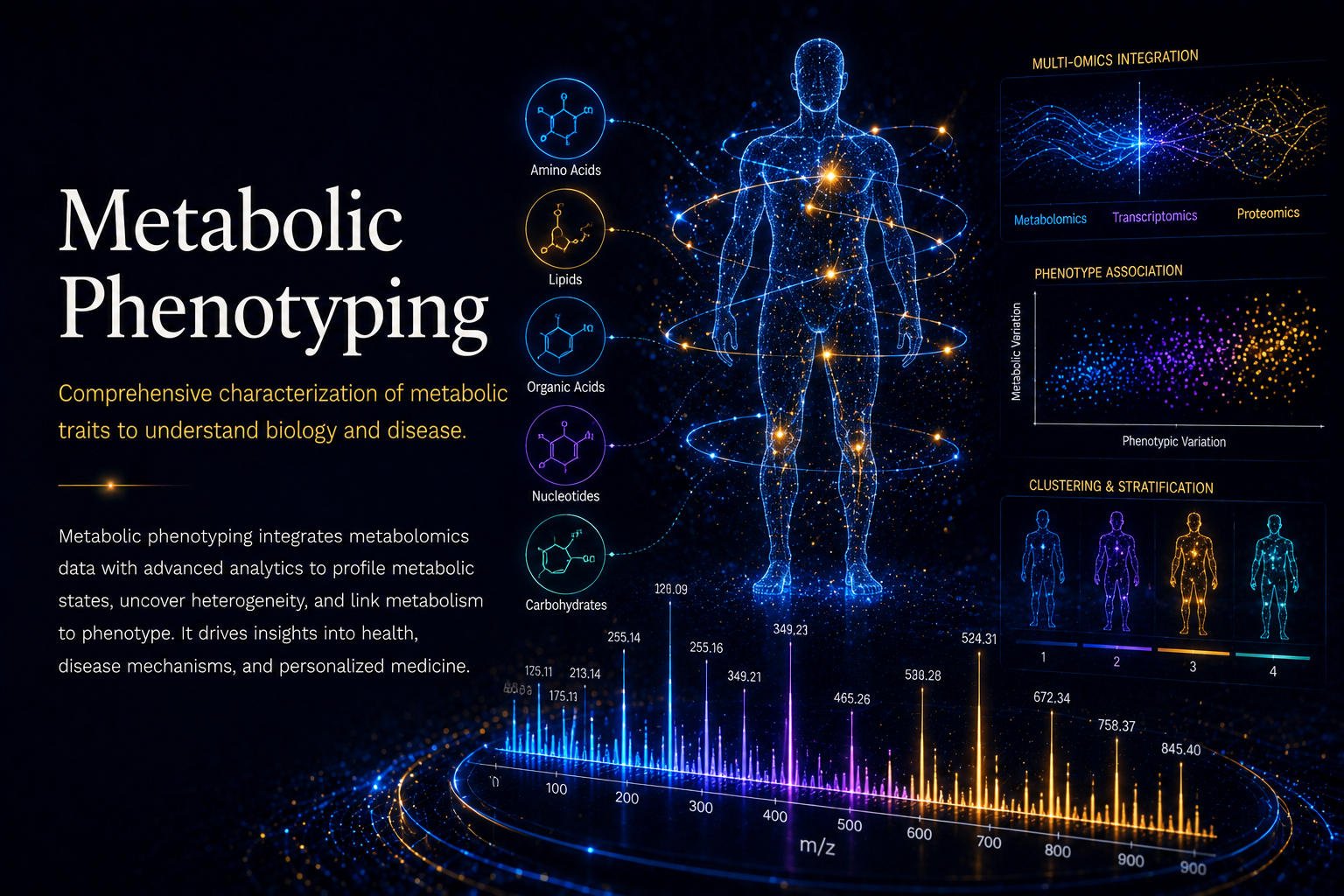
Research Overview
Metabolic phenotyping uses metabolite measurements to define the biochemical state of cells, tissues, organisms, or patients. Because metabolites reflect active physiology and pathway activity, metabolic phenotypes provide a direct window into biological function, disease mechanisms, treatment response, and environmental influence.
At PanorOmics, metabolic phenotyping is presented as a core metabolomics research area: a bridge between metabolite profiling, pathway biology, clinical interpretation, disease biomarkers, and multi-omics systems medicine.
Core Research Areas
Metabolic State Characterization
Defining the biochemical state of cells, tissues, organisms, or patients through metabolite patterns and pathway activity.
Phenotype–Metabolite Mapping
Connecting measurable metabolic profiles with biological traits, disease states, treatment response, and environmental exposures.
Clinical Metabolic Phenotyping
Using metabolite signatures to support patient stratification, disease classification, prognosis, and precision medicine research.
Systems-Level Metabolism
Interpreting metabolic phenotypes through pathways, networks, physiology, and integrated multi-omics data.
Metabolic Phenotyping Technologies
LC-MS / MS
Liquid chromatography mass spectrometry used for broad and sensitive metabolite detection across biological samples.
GC-MS
Gas chromatography mass spectrometry used for volatile, derivatized, and small-molecule metabolic profiling.
NMR Spectroscopy
Reproducible, non-destructive metabolite measurement technology used for metabolic phenotyping and clinical studies.
Targeted Metabolomics
Focused quantification of selected metabolites or pathways for hypothesis-driven phenotyping and validation.
AI-Assisted Phenotyping
Machine learning approaches that support metabolic classification, pattern discovery, and phenotype interpretation.
Metabolic Phenotyping Modalities
Untargeted Metabolic Phenotyping
Broad profiling of metabolites to discover biochemical patterns associated with biological or disease states.
Targeted Metabolic Phenotyping
Quantifies selected metabolites or pathways to test focused biological or clinical hypotheses.
Clinical Phenotyping
Uses metabolite patterns to classify patient groups, disease states, treatment response, or health trajectories.
Nutritional and Environmental Phenotyping
Links metabolic profiles with diet, lifestyle, exposure, microbiome activity, and environmental factors.
Longitudinal Phenotyping
Tracks metabolic changes over time during disease progression, development, treatment, or recovery.
Multi-omics Phenotyping
Combines metabolomics with genomics, transcriptomics, proteomics, lipidomics, and clinical data to define biological states.
Related metabolomic approaches such as metabolite profiling, pathway analysis, and disease biomarker discovery are explored across the Metabolomics Research Center.
Landmark Metabolic Phenotyping Milestones
Clinical Chemistry Foundations
Routine measurement of metabolites in blood and urine established small molecules as indicators of physiological and disease state.
Metabolic Disorder Profiling
Biochemical testing for inherited metabolic disorders demonstrated how metabolite patterns can define disease phenotypes.
Metabonomics and Metabolomics
High-throughput metabolic profiling expanded phenotype analysis from individual metabolites to system-wide metabolic signatures.
Mass Spectrometry Phenotyping
LC-MS, GC-MS, and related technologies enabled sensitive metabolic phenotyping across tissues, fluids, cohorts, and disease models.
Population and Clinical Metabolic Phenotyping
Large-scale studies increasingly link metabolic profiles with health records, disease risk, lifestyle, environment, and clinical outcomes.
Multi-omics Phenotype Integration
Integrated omics approaches connect metabolic phenotypes with genomic, transcriptomic, proteomic, lipidomic, and clinical information.
AI-Assisted Metabolic Phenotyping
AI increasingly supports phenotype classification, metabolic signature discovery, patient stratification, and precision medicine research.
Featured Publications
Metabolomics: The Link Between Genotypes and Phenotypes
The Human Metabolome Database
Metabonomics and Metabolic Phenotyping
Mass Spectrometry-Based Metabolomics
Clinical Metabolic Phenotyping
Multi-omics Phenotyping
Continue Your Research Journey
Metabolite Profiling →
Continue exploring the Metabolomics Research Center.
Pathway Analysis →
Continue exploring the Metabolomics Research Center.
Disease Biomarkers →
Continue exploring the Metabolomics Research Center.