Pathway Analysis
Pathway analysis interprets metabolite changes through biochemical pathways, helping researchers understand metabolic regulation, disease mechanisms, pathway disruption, and systems-level biological function.
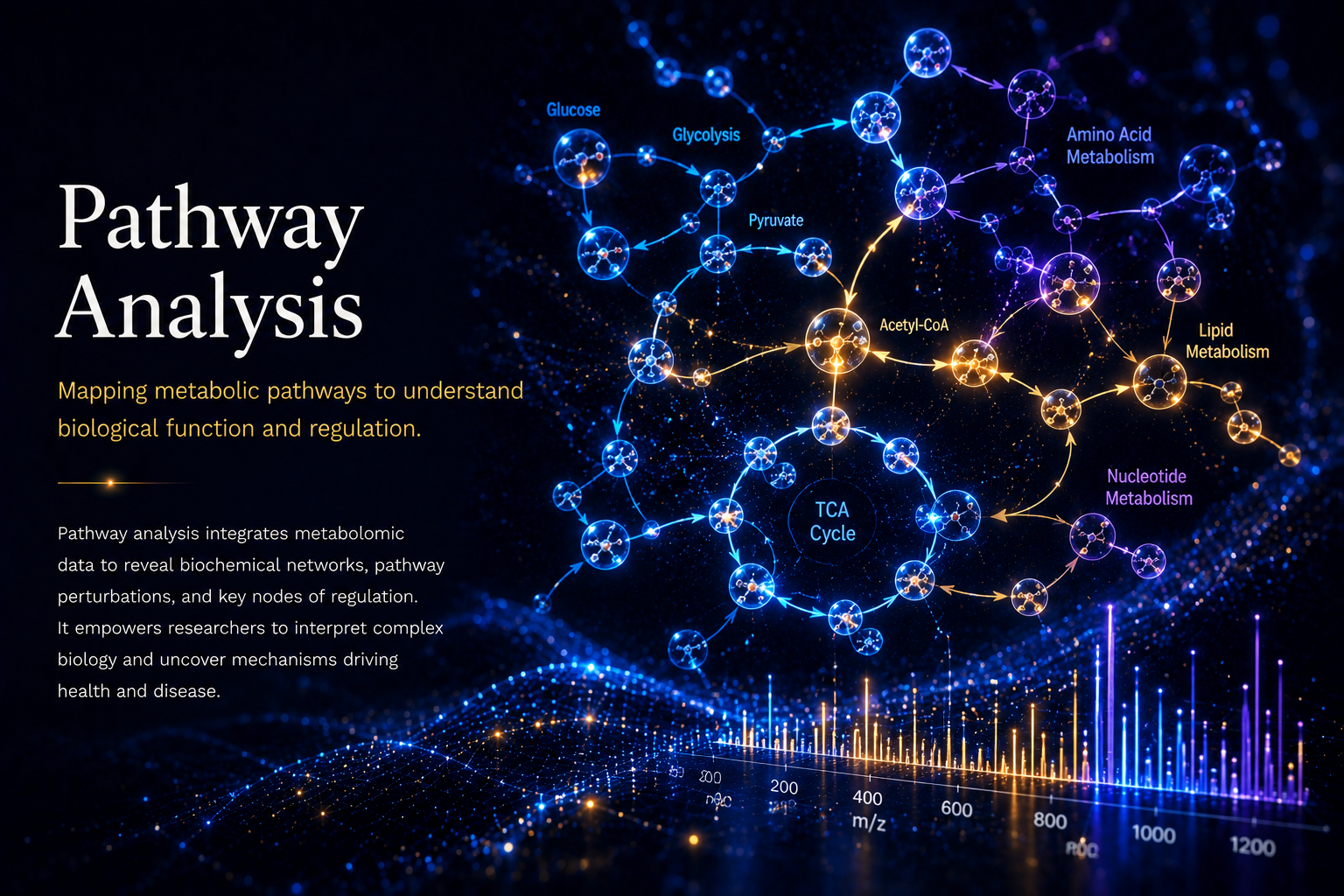
Research Overview
Pathway analysis transforms metabolite measurements into biological interpretation. Rather than viewing metabolites as isolated molecules, pathway analysis connects them to biochemical routes, enzyme activity, cellular regulation, disease mechanisms, and physiological state.
At PanorOmics, pathway analysis is presented as a core metabolomics research area: the interpretive layer that connects metabolite profiling, metabolic phenotyping, disease biomarkers, systems biology, and multi-omics integration.
Core Research Areas
Metabolic Pathway Mapping
Connecting metabolites to biochemical pathways to understand cellular metabolism, disease mechanisms, and biological regulation.
Pathway Enrichment Analysis
Identifying pathways that are overrepresented among altered metabolites across conditions, tissues, or disease states.
Network-Based Metabolomics
Interpreting metabolites through biochemical networks, pathway topology, enzyme activity, and systems-level relationships.
Multi-omics Pathway Integration
Combining metabolomics with genomics, transcriptomics, proteomics, lipidomics, and clinical data to understand pathway-level biology.
Pathway Analysis Technologies
LC-MS / MS
Liquid chromatography mass spectrometry used to detect metabolites that can be mapped to biochemical pathways.
GC-MS
Gas chromatography mass spectrometry used to measure small molecules involved in central carbon metabolism, amino acid metabolism, and organic acid pathways.
NMR Spectroscopy
Reproducible metabolite measurement technology used to study pathway-level metabolic patterns.
Pathway Databases
Resources such as KEGG, Reactome, HMDB, and MetaboAnalyst support metabolite annotation and pathway interpretation.
AI-Assisted Pathway Analysis
Machine learning and computational methods that support pathway prediction, network interpretation, and metabolic signature discovery.
Pathway Analysis Modalities
Central Carbon Metabolism
Analyzes pathways such as glycolysis, the TCA cycle, pentose phosphate pathway, and energy metabolism.
Amino Acid Metabolism
Studies amino acid pathways involved in biosynthesis, signaling, nitrogen balance, and disease-associated metabolic changes.
Lipid and Fatty Acid Pathways
Connects metabolite patterns with lipid metabolism, membrane biology, inflammation, and metabolic disease.
Redox and Oxidative Stress Pathways
Interprets metabolites involved in oxidative stress, antioxidant defense, mitochondrial function, and cellular damage.
Disease Pathway Signatures
Identifies altered metabolic pathways associated with cancer, diabetes, cardiovascular disease, neurodegeneration, and immune disorders.
Integrated Pathway Modeling
Combines metabolite data with genes, transcripts, proteins, enzymes, and clinical phenotypes to model biological systems.
Related metabolomic approaches such as metabolite profiling, metabolic phenotyping, and disease biomarker discovery are explored across the Metabolomics Research Center.
Landmark Pathway Analysis Milestones
Biochemical Pathway Foundations
Foundational metabolic pathways such as glycolysis and the citric acid cycle established the framework for understanding cellular metabolism.
Clinical Biochemistry and Pathway Disorders
Biochemical testing linked metabolite abnormalities to pathway dysfunction, inherited metabolic disease, and clinical phenotypes.
Metabolomics Pathway Interpretation
High-throughput metabolomics expanded pathway analysis from individual metabolites to system-wide biochemical patterns.
Pathway Database Expansion
Metabolic databases and pathway tools improved metabolite annotation, pathway mapping, and biological interpretation.
Network Metabolomics
Network-based approaches connected metabolites with enzymes, pathways, disease mechanisms, and systems biology.
Multi-omics Pathway Integration
Integrated omics approaches connect metabolic pathways with genomic, transcriptomic, proteomic, lipidomic, and clinical data.
AI-Assisted Pathway Analysis
AI increasingly supports metabolic pathway prediction, pathway enrichment, network modeling, and systems-level interpretation.
Featured Publications
Metabolomics: The Link Between Genotypes and Phenotypes
The Human Metabolome Database
MetaboAnalyst for Metabolomics Data Analysis
KEGG for Pathway Mapping
Metabolic Pathway Analysis in Systems Biology
Multi-omics Pathway Integration
Continue Your Research Journey
Metabolite Profiling →
Continue exploring the Metabolomics Research Center.
Metabolic Phenotyping →
Continue exploring the Metabolomics Research Center.
Disease Biomarkers →
Continue exploring the Metabolomics Research Center.