Non-coding RNA
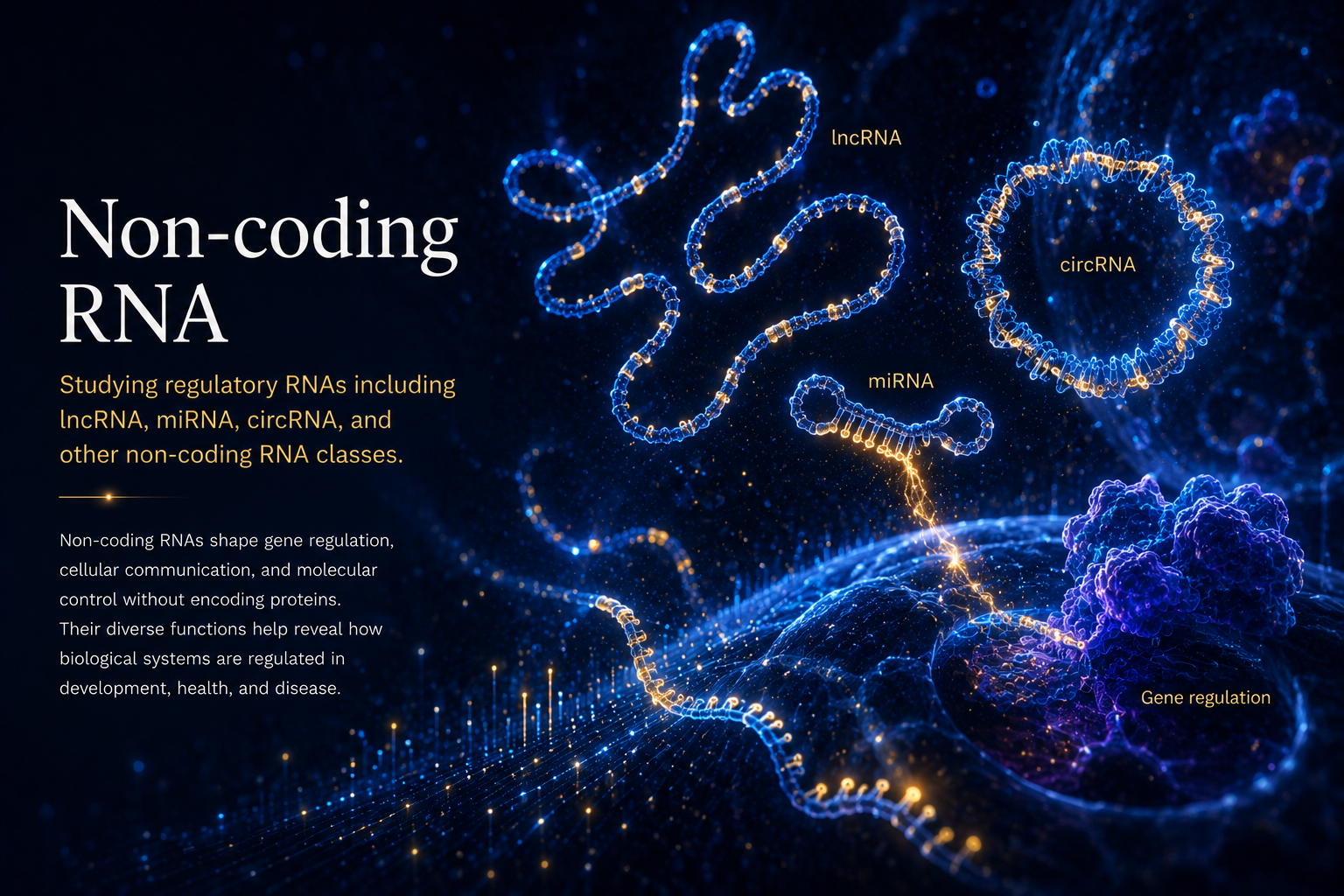
Non-coding RNA research explores RNA molecules that do not encode proteins but regulate gene expression, chromatin state, RNA stability, translation, signaling pathways, and disease-associated molecular programs.
Research Overview
Non-coding RNAs are central regulators of cellular identity, gene expression, development, and disease. They include long non-coding RNAs, microRNAs, circular RNAs, small regulatory RNAs, and other RNA species that influence transcriptional, post-transcriptional, and epigenetic regulation.
At PanorOmics, non-coding RNA is presented as a major transcriptomic research area: a regulatory layer connecting genome function, epigenomics, RNA expression, cancer biology, biomarker discovery, and precision medicine.
Core Research Areas
Long Non-coding RNA
Studying lncRNAs that regulate chromatin organization, transcription, RNA processing, signaling pathways, and disease-associated gene regulation.
MicroRNA Regulation
Analyzing microRNAs that control post-transcriptional gene expression by targeting messenger RNAs and shaping regulatory networks.
Circular RNA Biology
Investigating circular RNAs as stable regulatory molecules involved in gene expression control, RNA binding, and disease biology.
Non-coding RNA Biomarkers
Using non-coding RNA signatures to support disease classification, prognosis, therapeutic response prediction, and precision medicine research.
Non-coding RNA Technologies
RNA-seq
Sequencing-based transcriptome profiling used to detect and quantify coding and non-coding RNA species across biological samples.
Small RNA-seq
Specialized sequencing of small RNA molecules such as microRNAs, piRNAs, and other short regulatory RNAs.
Total RNA-seq
Ribo-depleted RNA sequencing that captures a broader range of coding and non-coding transcripts beyond polyadenylated RNA.
Single-cell RNA-seq
Single-cell transcriptomics used to study non-coding RNA expression patterns across individual cells and cell states.
qPCR / RT-qPCR
Targeted validation and quantification of specific non-coding RNAs in research and clinical biomarker studies.
Non-coding RNA Modalities
Long Non-coding RNA Profiling
Measures lncRNA expression patterns and their association with biological regulation, disease states, and molecular pathways.
MicroRNA Profiling
Quantifies microRNAs involved in post-transcriptional regulation, disease biology, and biomarker discovery.
Circular RNA Analysis
Identifies circular RNAs formed through back-splicing and evaluates their regulatory and biomarker potential.
Small RNA Analysis
Profiles short regulatory RNA species involved in gene silencing, genome defense, and post-transcriptional control.
Competing Endogenous RNA Networks
Models interactions among lncRNAs, circular RNAs, microRNAs, and mRNAs within regulatory RNA networks.
Clinical ncRNA Signatures
Uses non-coding RNA patterns to classify disease, predict outcomes, and support translational biomarker research.
Related transcriptomic approaches such as RNA expression, RNA sequencing, and alternative splicing are explored across the Transcriptomics Research Center.
Landmark Non-coding RNA Milestones
MicroRNA Discovery
The discovery of lin-4 revealed that small non-coding RNAs can regulate gene expression.
MicroRNA Field Expansion
The discovery of let-7 and broader microRNA conservation established microRNAs as important regulators across species.
Long Non-coding RNA Biology
Large-scale transcriptomic studies revealed that many non-coding transcripts participate in gene regulation, chromatin control, and disease biology.
Circular RNA Research
Circular RNAs emerged as stable regulatory RNA molecules with roles in gene expression control, RNA binding, and biomarker discovery.
Competing Endogenous RNA Networks
ceRNA models connected lncRNAs, circular RNAs, microRNAs, and mRNAs into broader post-transcriptional regulatory networks.
Single-cell Non-coding RNA Analysis
Single-cell transcriptomics began revealing cell-type-specific non-coding RNA expression patterns and regulatory programs.
AI-Assisted Non-coding RNA Interpretation
AI increasingly supports non-coding RNA annotation, target prediction, regulatory network modeling, and biomarker discovery.
Featured Publications
The C. elegans Heterochronic Gene lin-4 Encodes Small RNAs
The 21-Nucleotide let-7 RNA Regulates Developmental Timing
Identification of Novel Genes Coding for Small Expressed RNAs
The miRNA Registry
Circular RNAs Are a Large Class of Animal RNAs
A ceRNA Hypothesis
Continue Your Research Journey
RNA Expression →
Continue exploring the Transcriptomics Research Center.
RNA-seq →
Continue exploring the Transcriptomics Research Center.
Alternative Splicing →
Continue exploring the Transcriptomics Research Center.