RNA-seq
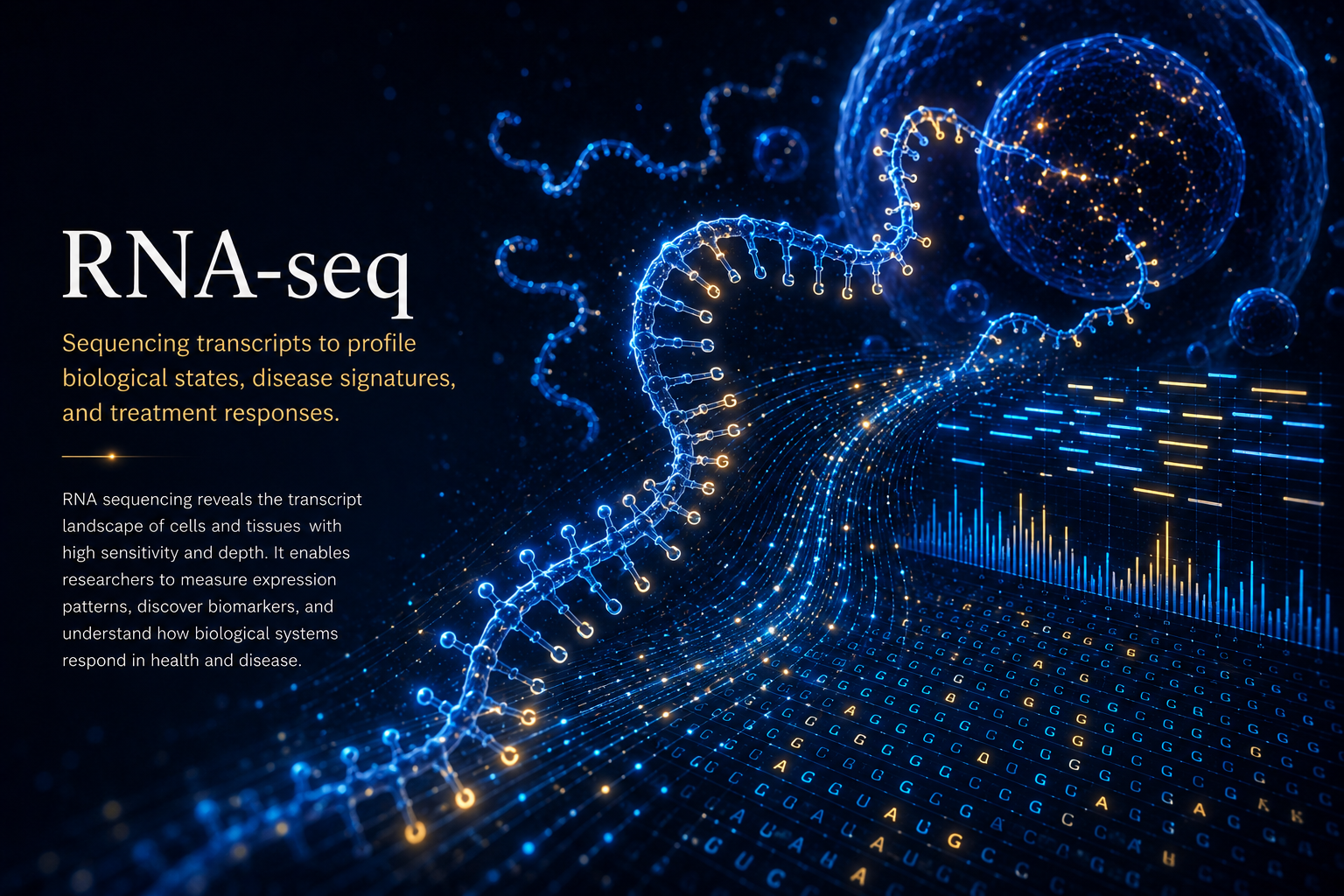
RNA sequencing uses high-throughput sequencing to measure RNA molecules across the transcriptome, revealing gene expression, transcript structure, splice variation, fusion transcripts, and dynamic molecular activity across biological systems.
Research Overview
RNA-seq transformed transcriptomics by replacing many array-based methods with sequencing-based measurement of RNA abundance and transcript structure. It allows researchers to quantify gene expression, discover novel transcripts, identify fusion events, study alternative splicing, and compare molecular programs across tissues, diseases, treatments, and cell states.
At PanorOmics, RNA-seq is presented as a core transcriptomic technology: a bridge between gene activity, cellular function, disease mechanisms, biomarker discovery, and integrated multi-omics analysis.
Core Research Areas
Transcriptome Profiling
Measuring RNA molecules across the transcriptome to understand gene activity, biological states, disease mechanisms, and cellular responses.
Differential Expression Analysis
Identifying genes whose expression changes across tissues, treatments, disease states, or experimental conditions.
Transcript Isoform Analysis
Characterizing alternative transcripts, splice isoforms, and RNA processing events that shape biological function.
Clinical RNA-seq Applications
Using RNA-seq to support biomarker discovery, disease classification, fusion detection, and precision medicine research.
RNA-seq Technologies
Bulk RNA-seq
Transcriptome-wide sequencing of RNA from tissues or cell populations to quantify average gene expression and pathway activity.
Single-cell RNA-seq
RNA sequencing at individual-cell resolution to reveal cell types, cellular heterogeneity, and dynamic transcriptional states.
Long-read RNA-seq
Sequencing full-length transcripts to improve isoform detection, alternative splicing analysis, and transcript annotation.
Spatial RNA-seq
Sequencing-based spatial transcriptomics that maps RNA expression within tissue architecture.
Ribo-depleted / Total RNA-seq
Captures coding and non-coding RNA species by depleting ribosomal RNA rather than selecting only polyadenylated transcripts.
RNA-seq Modalities
mRNA-seq
Profiles protein-coding messenger RNA expression across samples or biological states.
Total RNA-seq
Measures a broader range of RNA species, including coding and non-coding transcripts.
Single-cell RNA-seq
Profiles gene expression in individual cells to identify cell populations and cell-state transitions.
Long-read Transcript Sequencing
Captures full-length RNA transcripts to resolve isoforms and complex splicing patterns.
Fusion Transcript Detection
Identifies gene fusions and chimeric transcripts, especially in cancer transcriptomics.
Differential Transcript Usage
Detects changes in transcript isoform usage across biological or disease conditions.
Related transcriptomic approaches such as RNA expression, alternative splicing, and non-coding RNA analysis are explored across the Transcriptomics Research Center.
Landmark Transcriptomics Milestones
Expression Profiling Era
Gene expression microarrays and early transcript profiling established the foundation for transcriptome-scale analysis.
Next-Generation Sequencing Emerges
High-throughput sequencing technologies made it possible to measure RNA expression through sequencing rather than hybridization.
RNA Sequencing
RNA-seq transformed transcriptomics by enabling high-resolution, transcriptome-wide quantification of gene expression and transcript structure.
Single-cell RNA-seq
Single-cell RNA-seq expanded RNA-seq from bulk samples to individual cells, revealing cellular heterogeneity and rare cell states.
Clinical and Cancer RNA-seq
RNA-seq became increasingly important for tumor profiling, fusion detection, biomarker discovery, and disease classification.
Spatial Transcriptomics
Spatial sequencing approaches connected RNA expression with tissue structure, cell neighborhoods, and disease microenvironments.
AI-Assisted RNA-seq Interpretation
AI and computational biology increasingly support expression analysis, transcript annotation, cell-state discovery, and clinical RNA-seq interpretation.
Featured Publications
Mapping and Quantifying Mammalian Transcriptomes by RNA-seq
RNA-seq: A Revolutionary Tool for Transcriptomics
Transcriptome Sequencing to Detect Gene Fusions
Single-cell RNA-seq Reveals Cellular Heterogeneity
Spatial Transcriptomics
Long-read Transcriptome Sequencing
Continue Your Research Journey
RNA Expression →
Continue exploring the Transcriptomics Research Center.
Alternative Splicing →
Continue exploring the Transcriptomics Research Center.
Non-coding RNA →
Continue exploring the Transcriptomics Research Center.