RNA Expression
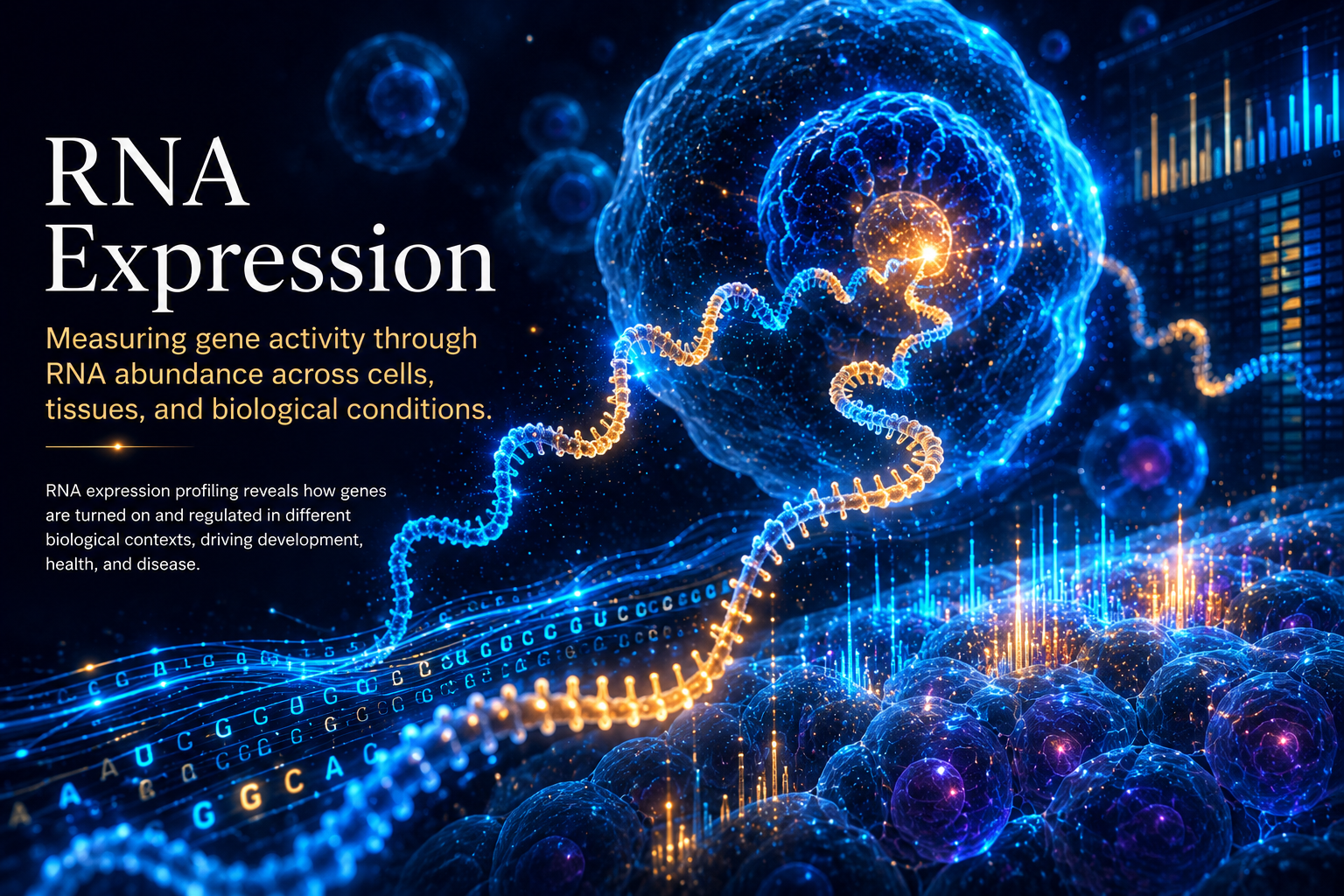
RNA expression reveals which genes are active, how strongly they are expressed, and how biological systems respond across tissues, cells, diseases, treatments, and environmental conditions.
Research Overview
RNA expression analysis is central to transcriptomics because it measures the dynamic activity of genes rather than the static sequence of DNA. By quantifying RNA levels, researchers can identify active pathways, compare biological states, classify disease subtypes, and understand how cells respond to internal and external signals.
At PanorOmics, RNA expression is presented as a foundational layer of transcriptomic discovery: the bridge between genomic information, cellular function, disease biology, biomarker discovery, and multi-omics interpretation.
Core Research Areas
Differential Gene Expression
Comparing RNA expression levels across tissues, disease states, treatments, or biological conditions to identify genes associated with function and phenotype.
Expression Signatures
Defining gene expression patterns that classify cell states, disease subtypes, biological pathways, and molecular responses.
Pathway-Level Expression Analysis
Interpreting RNA expression changes through biological pathways, regulatory networks, and systems-level functional programs.
Clinical RNA Biomarkers
Using RNA expression patterns to support disease classification, prognosis, therapeutic response prediction, and precision medicine research.
Expression Technologies
RNA Sequencing
High-throughput sequencing of RNA molecules to quantify gene expression and characterize transcriptome-wide activity.
Microarray Profiling
Hybridization-based measurement of gene expression across thousands of genes, widely used before RNA sequencing became dominant.
qPCR / RT-qPCR
Targeted quantitative measurement of RNA expression for validation, diagnostics, and focused gene expression studies.
Single-cell RNA-seq
Expression profiling at single-cell resolution to reveal cellular heterogeneity, rare cell states, and dynamic transcriptional programs.
Spatial Transcriptomics
RNA expression analysis within tissue architecture, preserving spatial relationships between cells and molecular activity.
Expression Modalities
Bulk RNA Expression
Measures average RNA expression across a tissue, sample, or cell population.
Single-cell RNA Expression
Profiles gene expression in individual cells to identify cell types, states, and heterogeneity.
Spatial RNA Expression
Maps gene expression patterns directly within tissue structure.
Targeted Expression Panels
Measures selected genes or pathways for focused biological or clinical questions.
Time-course Expression Profiling
Tracks RNA expression changes across development, treatment, stress, or disease progression.
Expression-Based Classification
Uses RNA signatures to classify disease subtypes, biological states, or therapeutic response groups.
Related transcriptomic approaches such as RNA sequencing, alternative splicing, and non-coding RNA analysis are explored across the Transcriptomics Research Center.
Landmark Transcriptomics Milestones
Northern Blotting
RNA detection methods made it possible to measure specific gene transcripts and study gene expression experimentally.
RT-PCR and Quantitative Expression Analysis
Reverse transcription PCR and later quantitative PCR enabled sensitive targeted measurement of RNA expression.
Gene Expression Microarrays
Microarrays allowed thousands of genes to be measured simultaneously, transforming transcriptome-scale expression profiling.
RNA Sequencing
RNA-seq replaced many array-based approaches by enabling high-resolution, transcriptome-wide expression analysis.
Single-cell RNA Expression
Single-cell RNA-seq revealed cellular heterogeneity by measuring gene expression at individual-cell resolution.
Spatial Transcriptomics
Spatial methods connected RNA expression patterns with tissue architecture and cellular microenvironments.
AI-Assisted RNA Expression Analysis
AI increasingly supports expression signature discovery, cell-state classification, pathway interpretation, and clinical transcriptomics.
Featured Publications
Expression Monitoring by Hybridization to High-Density Oligonucleotide Arrays
Serial Analysis of Gene Expression
Mapping and Quantifying Mammalian Transcriptomes by RNA-seq
Transcriptome Sequencing to Detect Gene Fusions
Single-cell RNA-seq Reveals Cellular Heterogeneity
Spatial Transcriptomics
Continue Your Research Journey
RNA-seq →
Continue exploring the Transcriptomics Research Center.
Alternative Splicing →
Continue exploring the Transcriptomics Research Center.
Non-coding RNA →
Continue exploring the Transcriptomics Research Center.