Chromatin Accessibility
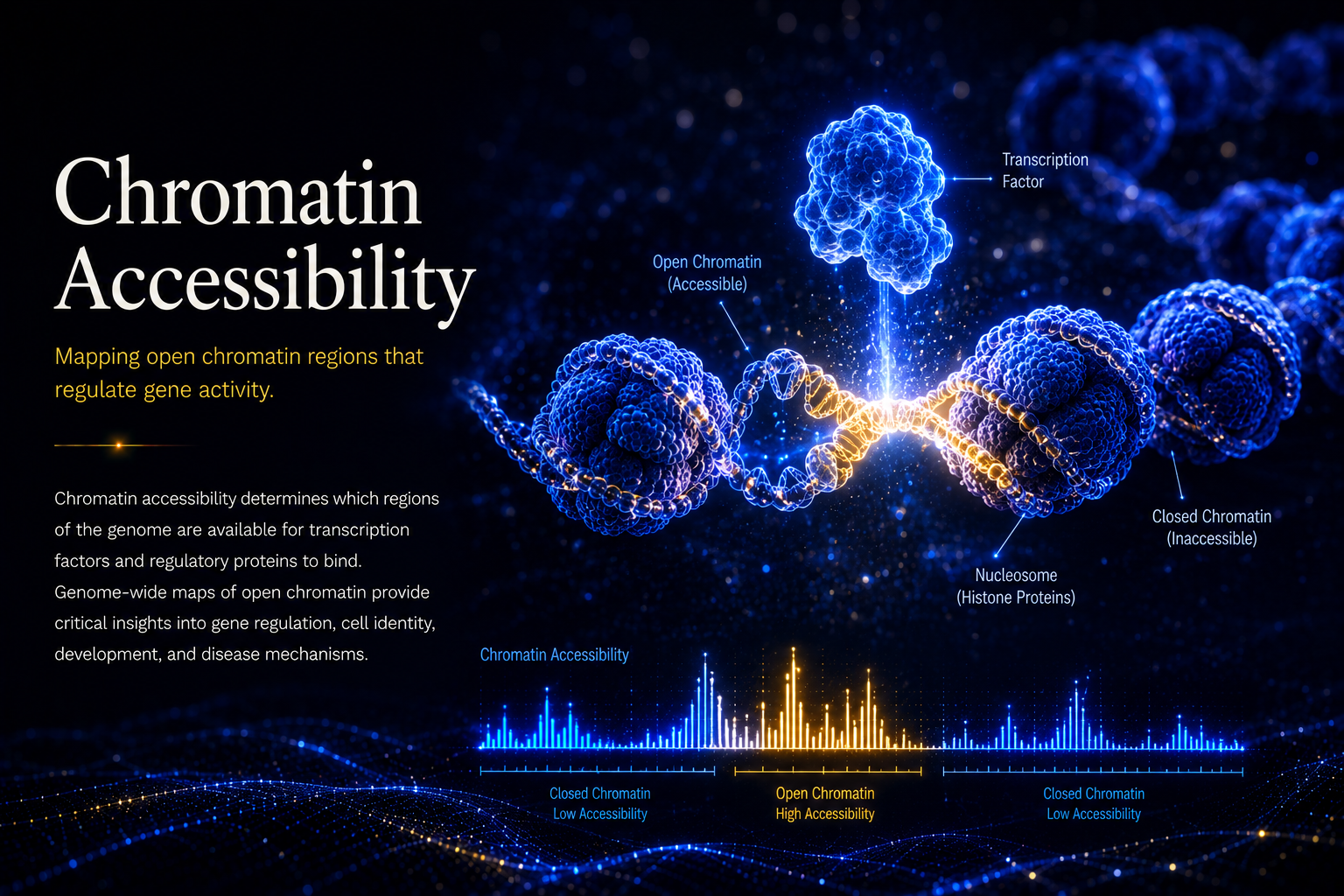
Chromatin accessibility research maps open regions of the genome where regulatory proteins can bind DNA, revealing how cells control gene expression, identity, differentiation, and disease-associated regulatory programs.
Research Overview
Chromatin accessibility is a central layer of epigenomic regulation. Accessible chromatin regions often mark promoters, enhancers, silencers, and other regulatory elements that influence whether genes are active, poised, or repressed.
At PanorOmics, chromatin accessibility is presented as a core epigenomics research area: a bridge between genome regulation, transcription factor activity, cell identity, disease mechanisms, precision medicine, and multi-omics regulatory interpretation.
Core Research Areas
Open Chromatin Mapping
Identifying accessible regions of the genome where regulatory proteins can bind and influence gene expression.
Regulatory Element Discovery
Detecting promoters, enhancers, silencers, and other regulatory DNA elements involved in transcriptional control.
Cell-State Epigenomics
Analyzing chromatin accessibility patterns that define cell identity, differentiation, disease states, and cellular response.
Disease-Associated Chromatin Remodeling
Studying how altered chromatin accessibility contributes to cancer, immune disease, neurological disorders, aging, and therapeutic resistance.
Chromatin Accessibility Technologies
ATAC-seq
Assay for transposase-accessible chromatin sequencing used to map open chromatin regions genome-wide.
DNase-seq
Sequencing-based method that identifies DNase I hypersensitive sites associated with accessible regulatory DNA.
FAIRE-seq
Chromatin accessibility method that enriches nucleosome-depleted DNA regions for regulatory element analysis.
Single-cell ATAC-seq
Single-cell chromatin accessibility profiling used to study regulatory heterogeneity across individual cells.
AI-Assisted Chromatin Analysis
Computational approaches that support regulatory element prediction, cell-state classification, and disease-associated chromatin interpretation.
Chromatin Accessibility Modalities
Promoter Accessibility
Measures accessibility near transcription start sites to study gene activation and regulatory potential.
Enhancer Accessibility
Identifies distal regulatory elements that control cell-type-specific and disease-associated gene expression.
Single-cell Chromatin Accessibility
Profiles regulatory landscapes in individual cells to reveal cell states, lineages, and epigenomic heterogeneity.
Chromatin Remodeling Analysis
Studies changes in nucleosome positioning, regulatory architecture, and genome accessibility across biological conditions.
Transcription Factor Footprinting
Infers transcription factor binding activity from chromatin accessibility patterns.
Multi-omics Regulatory Integration
Combines accessibility data with DNA methylation, histone marks, RNA expression, genomics, and clinical data.
Related epigenomic approaches such as DNA methylation, histone modification analysis, and disease epigenomics are explored across the Epigenomics Research Center.
Landmark Chromatin Accessibility Milestones
DNase Hypersensitivity
DNase hypersensitive sites established that accessible chromatin regions are associated with active regulatory DNA.
Genome-Wide Regulatory Mapping
Large-scale genomic methods expanded chromatin accessibility research from individual loci to genome-wide regulatory landscapes.
DNase-seq and Regulatory Genomics
Sequencing-based chromatin accessibility methods improved genome-wide mapping of open chromatin and regulatory elements.
ATAC-seq
ATAC-seq enabled fast, sensitive, genome-wide profiling of accessible chromatin across cells, tissues, and disease models.
Single-cell Chromatin Accessibility
Single-cell ATAC-seq revealed regulatory heterogeneity, cell-state transitions, and lineage-specific chromatin programs.
Multi-omics Epigenomic Integration
Integrated epigenomic approaches connect chromatin accessibility with gene expression, DNA methylation, histone marks, and disease biology.
AI-Assisted Chromatin Accessibility Interpretation
AI increasingly supports regulatory element prediction, transcription factor activity inference, cell-state classification, and disease epigenomics.
Featured Publications
Chromatin Structure and Gene Regulation
Genome-Wide Mapping of DNase Hypersensitive Sites
An Assay for Transposase-Accessible Chromatin Using Sequencing
Single-cell Chromatin Accessibility Reveals Regulatory Variation
ENCODE Regulatory Element Mapping
AI Models of Chromatin Accessibility and Gene Regulation
Continue Your Research Journey
DNA Methylation →
Continue exploring the Epigenomics Research Center.
Histone Modifications →
Continue exploring the Epigenomics Research Center.
Disease Epigenomics →
Continue exploring the Epigenomics Research Center.