Disease Epigenomics
Disease epigenomics studies how DNA methylation, histone modifications, chromatin accessibility, and regulatory programs are altered in cancer, aging, immune disease, metabolic dysfunction, and therapeutic response.
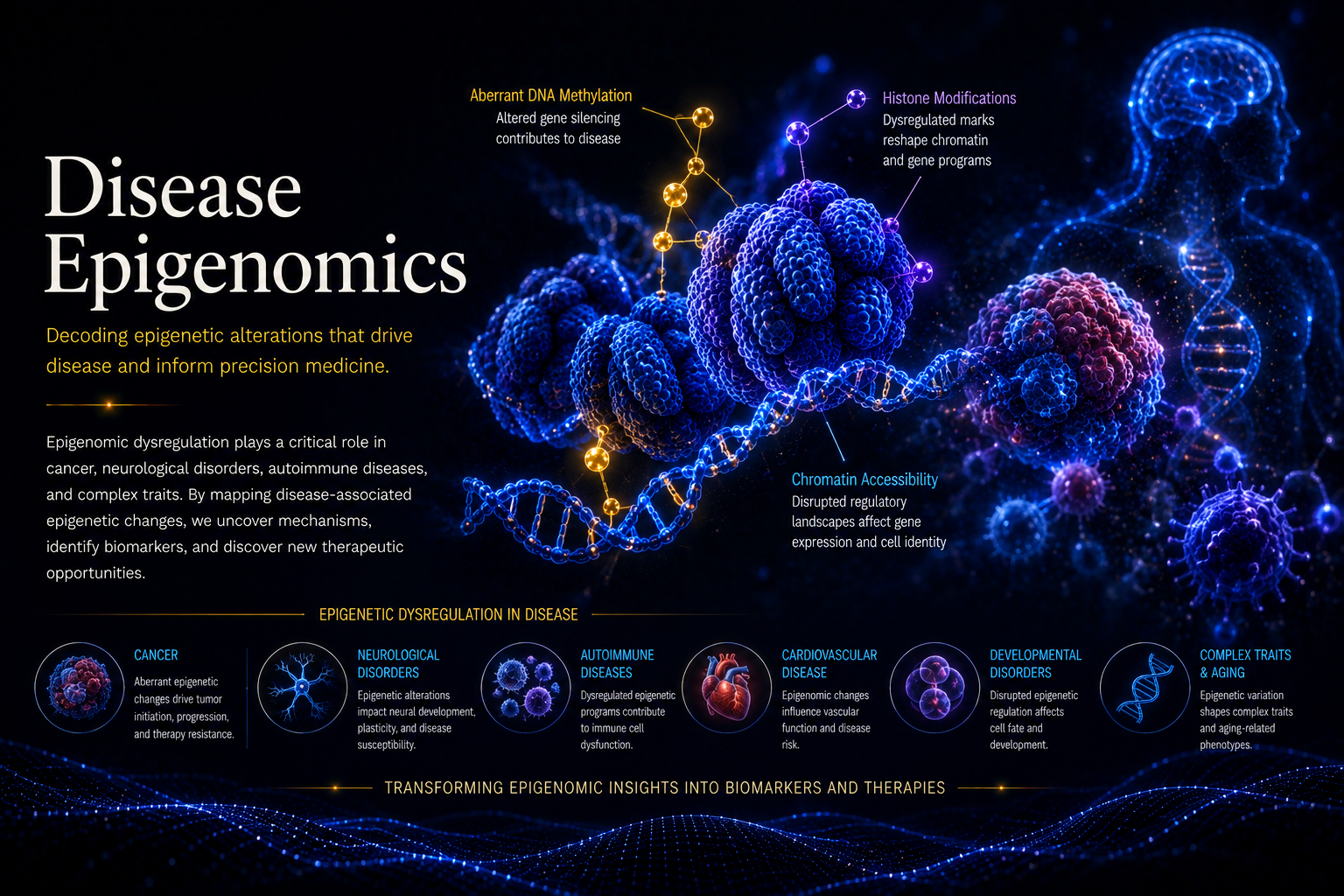
Research Overview
Disease epigenomics examines how epigenetic regulation changes during disease initiation, progression, adaptation, and treatment response. Unlike DNA sequence mutations, epigenomic changes can dynamically regulate gene activity without altering the underlying genome sequence.
At PanorOmics, disease epigenomics is presented as a core epigenomics research area: a bridge between genome regulation, cancer biology, aging, immune regulation, biomarker discovery, therapeutic resistance, and precision medicine.
Core Research Areas
Cancer Epigenomics
Studying DNA methylation, histone modifications, chromatin accessibility, and regulatory disruption in tumor initiation, progression, and therapeutic resistance.
Aging and Epigenetic Drift
Analyzing age-associated epigenomic changes, epigenetic clocks, cellular aging, and disease susceptibility.
Immune and Inflammatory Epigenomics
Investigating how epigenomic regulation shapes immune activation, inflammation, infection response, and autoimmune disease.
Clinical Epigenomic Biomarkers
Using epigenomic signatures to support disease classification, prognosis, therapeutic response prediction, and precision medicine research.
Disease Epigenomics Technologies
DNA Methylation Profiling
Genome-wide measurement of methylation patterns associated with gene regulation, disease state, aging, and clinical biomarkers.
ChIP-seq / CUT&Tag
Methods used to map histone modifications and chromatin-associated proteins involved in disease regulation.
ATAC-seq
Chromatin accessibility profiling used to detect regulatory regions altered in disease states and cellular transitions.
Single-cell Epigenomics
Single-cell methods that reveal epigenomic heterogeneity across cell populations, tumors, tissues, and disease microenvironments.
AI-Assisted Disease Epigenomics
Computational approaches that support biomarker discovery, patient stratification, regulatory interpretation, and disease classification.
Disease Epigenomics Modalities
Epigenetic Biomarker Discovery
Identifies disease-associated methylation, chromatin, and histone signatures for translational research.
Tumor Epigenomic Profiling
Maps epigenomic alterations in cancer to understand tumor biology, subtype identity, and therapeutic resistance.
Aging Epigenomics
Studies epigenetic drift, methylation clocks, cellular senescence, and age-related disease risk.
Environmental Epigenomics
Examines how exposures, lifestyle, stress, diet, and environment influence disease-associated epigenomic regulation.
Single-cell Disease Epigenomics
Profiles epigenomic variation across individual cells to reveal disease heterogeneity and cell-state transitions.
Multi-omics Disease Integration
Combines epigenomics with genomics, transcriptomics, proteomics, metabolomics, lipidomics, and clinical data.
Related epigenomic approaches such as DNA methylation, histone modification analysis, and chromatin accessibility are explored across the Epigenomics Research Center.
Landmark Disease Epigenomics Milestones
Epigenetic Regulation in Disease
Research increasingly linked DNA methylation, chromatin state, and gene regulation with cancer and human disease.
Cancer Epigenomics
Genome-wide epigenomic profiling revealed widespread methylation and chromatin alterations across tumor types.
Epigenetic Biomarker Discovery
Disease-associated epigenomic signatures increasingly support biomarker discovery, disease classification, and clinical research.
Epigenetic Clocks and Aging
DNA methylation-based epigenetic clocks strengthened the link between epigenomic change, biological aging, and disease risk.
Single-cell Disease Epigenomics
Single-cell epigenomic methods revealed disease heterogeneity, regulatory cell states, and tumor microenvironment complexity.
Multi-omics Disease Epigenomics
Integrated omics approaches connect epigenomic regulation with gene expression, mutations, proteins, metabolites, and clinical phenotypes.
AI-Assisted Disease Epigenomic Interpretation
AI increasingly supports epigenomic biomarker discovery, disease subtype classification, regulatory modeling, and precision medicine research.
Featured Publications
DNA Methylation and Human Disease
Cancer Epigenomics and DNA Methylation
DNA Methylation Age of Human Tissues and Cell Types
The Cancer Genome Atlas Epigenomic Studies
Single-cell Epigenomics in Disease
AI Models for Disease Epigenomics
Continue Your Research Journey
DNA Methylation →
Continue exploring the Epigenomics Research Center.
Histone Modifications →
Continue exploring the Epigenomics Research Center.
Chromatin Accessibility →
Continue exploring the Epigenomics Research Center.