Histone Modifications
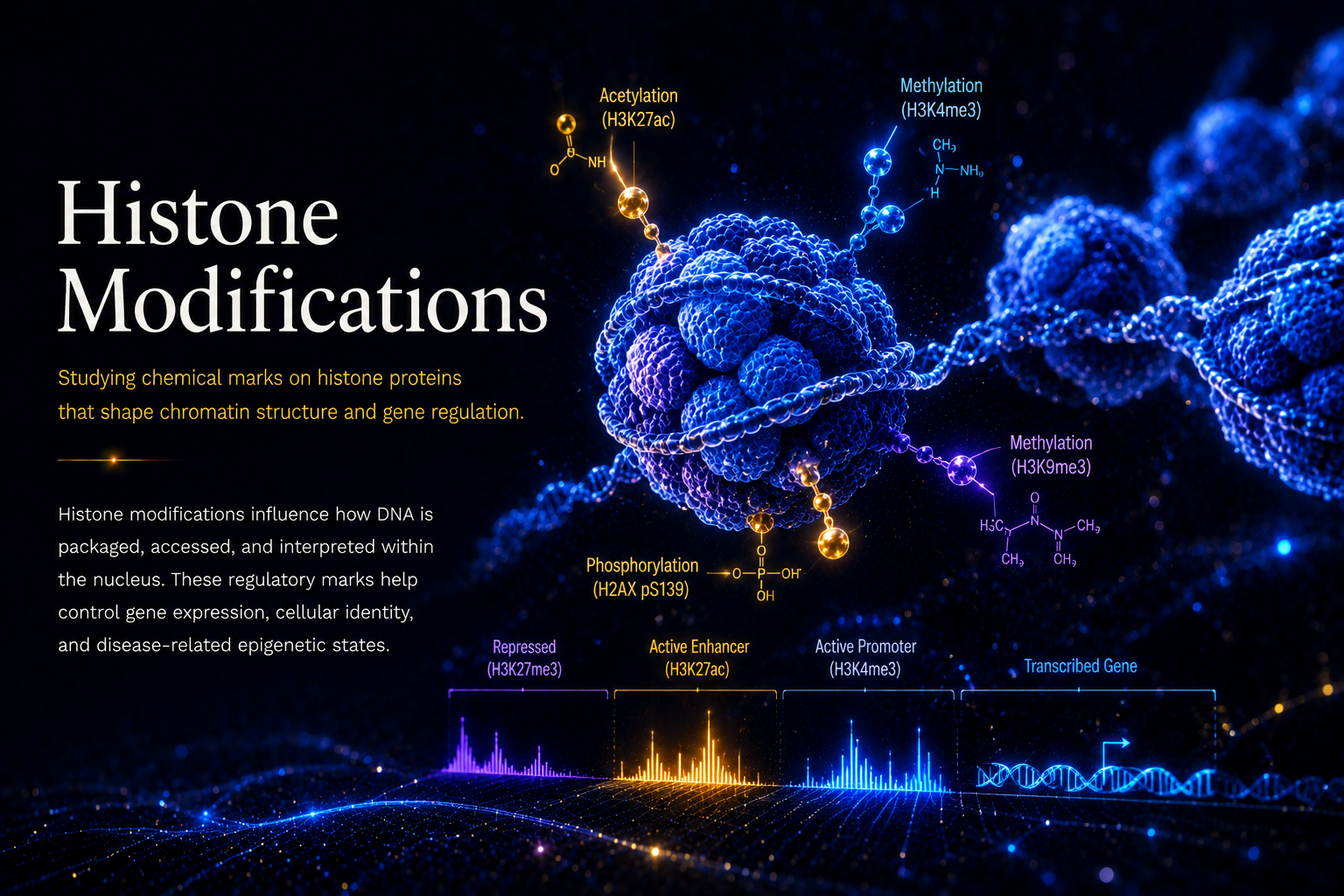
Histone modification research studies chemical marks on histone proteins that regulate chromatin structure, gene activity, enhancer function, cellular identity, disease mechanisms, and epigenomic control.
Research Overview
Histone modifications are a major layer of epigenomic regulation. Chemical marks such as acetylation, methylation, phosphorylation, and ubiquitination influence how tightly DNA is packaged, how regulatory elements function, and whether genes are active, poised, or repressed.
At PanorOmics, histone modifications are presented as a core epigenomics research area: a bridge between chromatin structure, gene regulation, transcriptional control, disease epigenomics, biomarker discovery, and multi-omics interpretation.
Core Research Areas
Histone Mark Mapping
Studying chemical modifications on histone proteins that influence chromatin structure, gene regulation, and cellular identity.
Chromatin State Regulation
Analyzing how combinations of histone marks define active, repressed, poised, or enhancer-associated chromatin states.
Epigenetic Gene Control
Investigating how histone acetylation, methylation, phosphorylation, and other marks regulate transcriptional programs.
Disease-Associated Histone Dysregulation
Identifying altered histone modification patterns linked to cancer, aging, immune disease, neurological disorders, and therapeutic resistance.
Histone Modification Technologies
ChIP-seq
Chromatin immunoprecipitation sequencing used to map histone modifications and chromatin-associated proteins genome-wide.
CUT&RUN
Targeted chromatin profiling method used to map histone marks and protein-DNA interactions with lower input requirements.
CUT&Tag
Tagmentation-based chromatin profiling method used to map histone modifications and regulatory proteins efficiently.
Mass Spectrometry Histone Proteomics
Proteomic analysis used to characterize histone modification combinations, abundance, and regulatory complexity.
AI-Assisted Histone Mark Analysis
Computational approaches that support chromatin-state prediction, regulatory interpretation, disease classification, and epigenomic modeling.
Histone Modification Modalities
Histone Acetylation
Studies acetylation marks often associated with open chromatin, active enhancers, and transcriptional activation.
Histone Methylation
Analyzes methylation marks that can indicate active, repressed, or poised regulatory states depending on genomic context.
Enhancer and Promoter Marks
Maps histone signatures such as H3K27ac, H3K4me1, and H3K4me3 to identify regulatory elements.
Repressive Chromatin Marks
Studies marks such as H3K27me3 and H3K9me3 associated with gene repression and heterochromatin regulation.
Histone Code Integration
Interprets combinations of histone modifications that coordinate chromatin structure and gene regulation.
Single-cell Chromatin State Analysis
Profiles histone-associated regulatory states across individual cells to reveal epigenomic heterogeneity.
Related epigenomic approaches such as chromatin accessibility, disease epigenomics, and DNA methylation are explored across the Epigenomics Research Center.
Landmark Histone Modification Milestones
Histone Modification Foundations
Early chromatin research established that histone chemical modifications are associated with gene regulation and chromatin structure.
Histone Acetylation and Transcription
Histone acetylation became strongly linked with transcriptional activation and dynamic chromatin regulation.
Histone Code Concept
The histone code concept framed combinations of histone marks as regulatory information influencing chromatin state and gene activity.
Genome-Wide Histone Mark Mapping
ChIP-seq enabled genome-wide mapping of histone modifications across promoters, enhancers, repressed regions, and disease-associated regulatory landscapes.
Low-Input Chromatin Profiling
CUT&RUN, CUT&Tag, and related methods expanded histone modification profiling to lower-input samples and complex biological systems.
Single-cell Chromatin State Profiling
Single-cell epigenomic approaches increasingly reveal cell-type-specific histone-associated regulatory states and disease heterogeneity.
AI-Assisted Histone Modification Interpretation
AI increasingly supports chromatin-state prediction, regulatory element annotation, disease epigenomics, and multi-omics interpretation.
Featured Publications
The Histone Code Hypothesis
Chromatin States and Gene Regulation
Genome-Wide Mapping of Histone Modifications
ENCODE Regulatory Element Mapping
CUT&RUN and CUT&Tag Chromatin Profiling
AI Models for Chromatin State and Histone Marks
Continue Your Research Journey
Chromatin Accessibility →
Continue exploring the Epigenomics Research Center.
Disease Epigenomics →
Continue exploring the Epigenomics Research Center.
DNA Methylation →
Continue exploring the Epigenomics Research Center.