Population Genomics
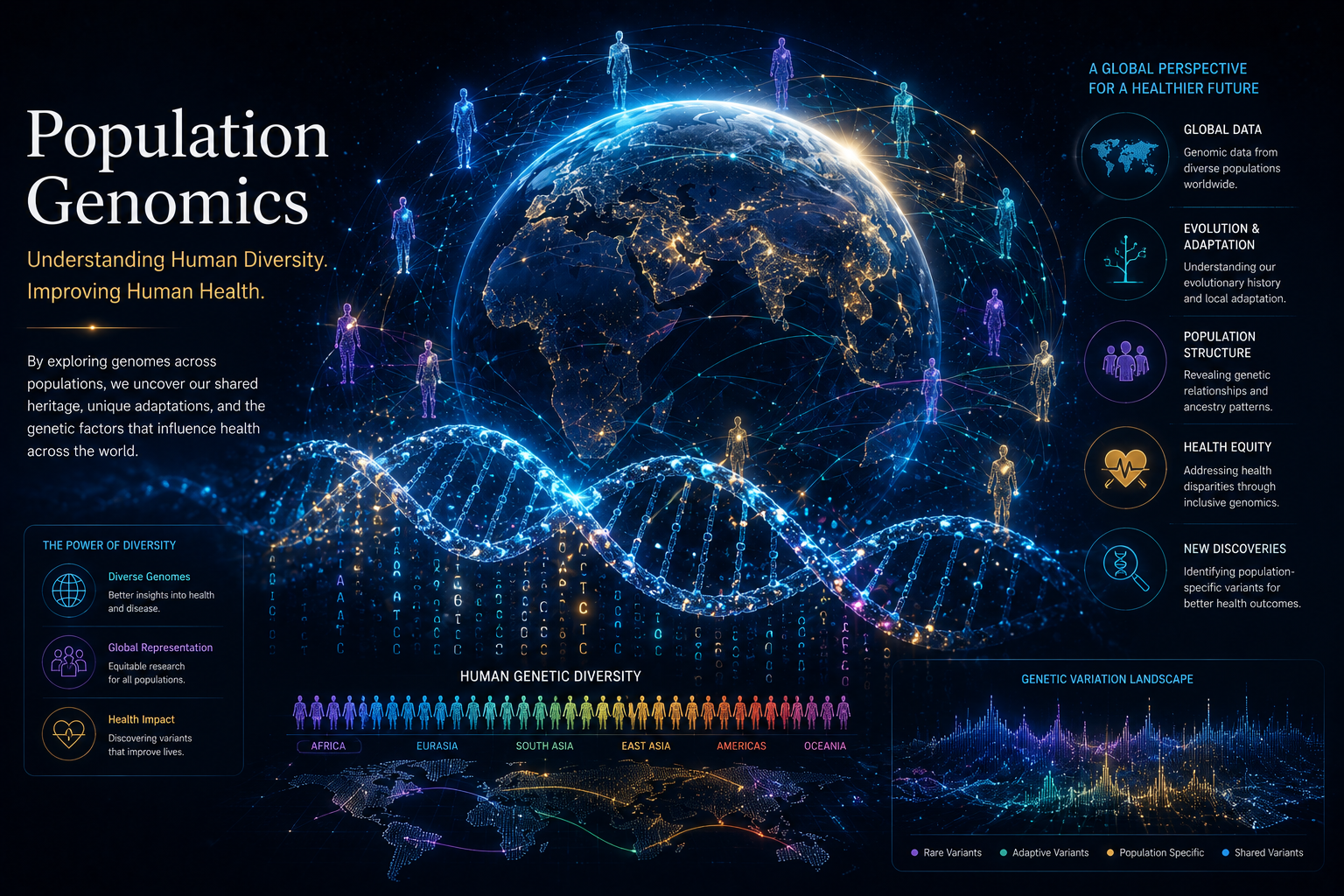
Population genomics studies genetic variation across individuals and populations to understand ancestry, evolution, disease susceptibility, public health, and global precision medicine. It connects genomic diversity to biology at the scale of people, communities, and populations.
Research Overview
Population genomics examines how genetic variation is distributed across populations and how evolutionary history, migration, natural selection, demography, and environmental pressures shape genomes over time. These approaches provide essential insights into ancestry, adaptation, complex disease, and human diversity.
At PanorOmics, population genomics represents the large-scale human dimension of genomics. It links genome sequencing, variant discovery, and precision medicine to population structure, epidemiology, and global biological understanding.
Core Research Areas
Human Genetic Diversity
Understanding how genomic variation differs across individuals and populations, and how this diversity shapes biological traits, ancestry, and disease risk.
Population Genetics
Studying allele frequencies, recombination, selection, drift, and demographic processes that shape genomes across generations.
Evolutionary Genomics
Exploring how genomes change over time to reveal adaptation, evolutionary history, comparative biology, and species relationships.
Genomic Epidemiology
Applying genomic data to investigate disease transmission, pathogen evolution, outbreak surveillance, and public health dynamics.
Global Genomic Resources
Human Genome Project
Established the first reference framework for modern human genomics and large-scale biological data.
1000 Genomes Project
Created a global catalog of common and low-frequency human genetic variation across populations.
Human Pangenome Reference Consortium
Expanded reference genomics beyond a single human genome to better capture global diversity.
UK Biobank
A major population resource linking genomic data with rich phenotype and health information.
All of Us Research Program
A large-scale precision medicine initiative designed to improve representation and diversity in biomedical research.
Human Cell Atlas
A global effort to map human cells and their molecular states across tissues and populations.
Population Genomic Methods
Genome-wide Association Studies (GWAS)
Associating common genetic variants with traits, disease susceptibility, and complex human phenotypes.
Population Structure Analysis
Modeling ancestry, clustering, and demographic structure across populations and cohorts.
Haplotype Analysis
Studying linked genetic variants inherited together across chromosomes and populations.
Admixture Analysis
Investigating mixed ancestry and the genomic contributions of multiple ancestral populations.
Phylogenomics
Using genomic data to reconstruct evolutionary relationships and population histories.
Polygenic Risk Scores
Aggregating many genetic variants to estimate risk for complex disease and precision health applications.
Landmark Discoveries
Human Genome Project
Established the first reference framework for studying human genetic variation at genome scale.
International HapMap Project
Mapped common patterns of human genetic variation and linkage disequilibrium, supporting population genetics and genome-wide association studies.
1000 Genomes Project
Transformed the study of global human variation through population-scale sequencing across diverse populations.
Biobank-Scale Genomics
Large biobanks link genomic data with phenotypes, health records, ancestry, environment, and population health outcomes.
Human Pangenome Reference
Improves reference genomics by representing broader human genomic diversity beyond a single linear reference genome.
Global Precision Medicine
Population genomics increasingly informs risk prediction, public health, ancestry-aware analysis, and more inclusive precision medicine.
Featured Publications
The International HapMap Project
A Map of Human Genome Variation from Population-Scale Sequencing
Genome-wide Association Studies and Human Disease
The UK Biobank Resource with Deep Phenotyping and Genomic Data
A Draft Human Pangenome Reference
Population Genomics in Precision Medicine
Continue Your Research Journey
Genome Sequencing →
Continue exploring the Genomics Research Center.
Variant Discovery →
Continue exploring the Genomics Research Center.
Precision Medicine →
Continue exploring the Genomics Research Center.