Variant Discovery
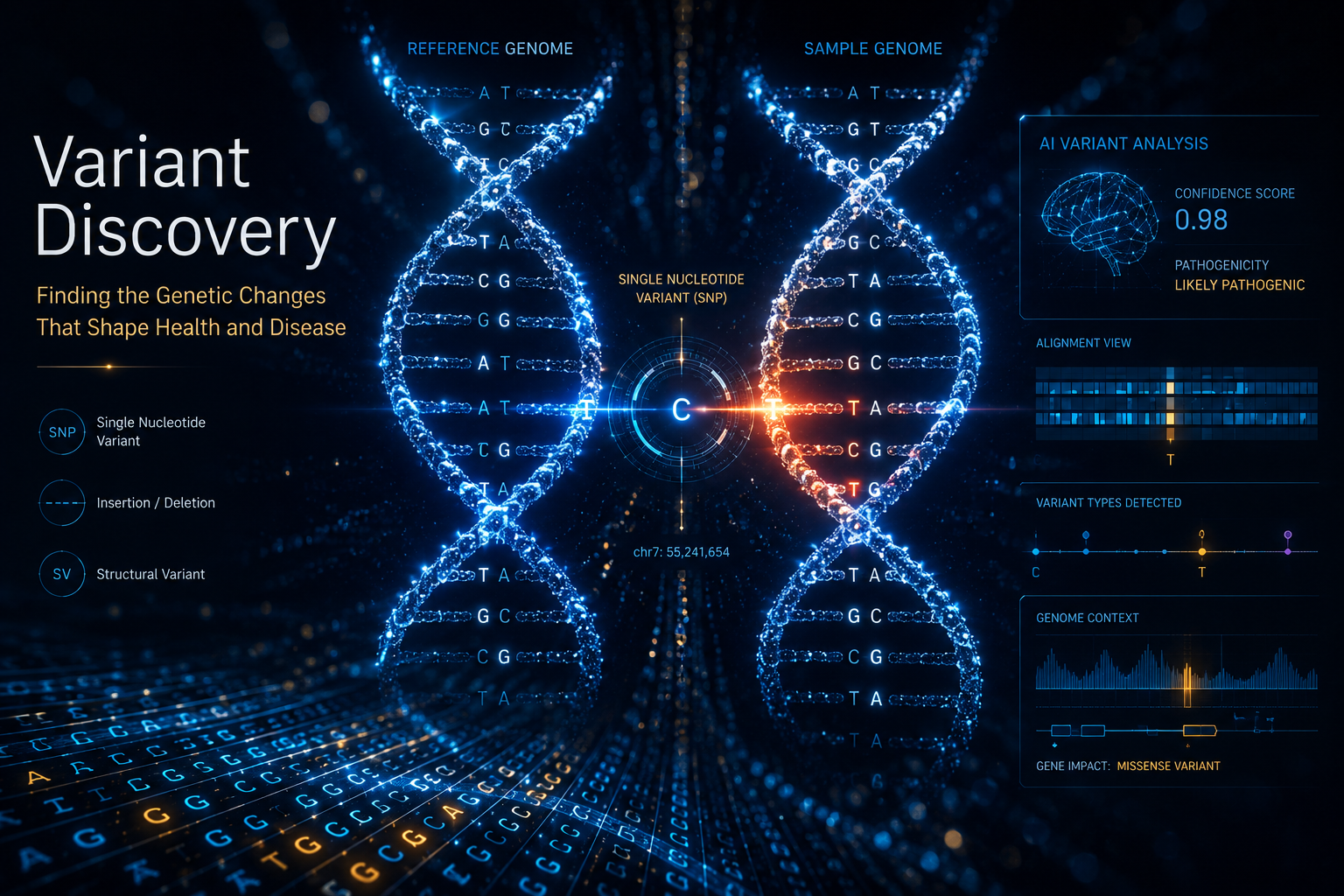
Variant discovery identifies the genetic changes that shape biological diversity, inherited disease, cancer evolution, and therapeutic response. By transforming sequencing data into interpretable genomic differences, this field connects raw DNA information to biological meaning and clinical relevance.
Research Overview
Variant discovery is central to modern genomics because genomes are not biologically meaningful unless their differences can be detected, classified, and interpreted. Researchers analyze inherited and acquired variation to understand development, disease mechanisms, tumor progression, drug response, and population diversity.
At PanorOmics, variant discovery is presented as the analytical bridge between genome sequencing and genomic medicine. It converts sequencing reads into variants, then links those variants to genes, pathways, disease processes, and biological interpretation.
Core Research Areas
Single Nucleotide Variants (SNVs) & SNPs
Identifying single-base changes across the genome to understand inherited variation, somatic mutation, and disease-associated genetic diversity.
Insertions & Deletions (Indels)
Detecting small insertions and deletions that disrupt coding sequences, alter regulatory regions, and influence biological function.
Structural Variants (SVs)
Studying large-scale genomic changes such as inversions, translocations, duplications, and complex rearrangements that reshape genomes.
Copy Number Variants (CNVs)
Analyzing gains and losses of genomic segments that contribute to developmental disorders, cancer, and population diversity.
Variant Analysis Pipeline
Sequencing reads generated from genome sequencing experiments.
Assessing read quality, filtering low-quality bases, and identifying technical artifacts.
Mapping sequencing reads to a reference genome to establish genomic coordinates.
Identifying putative SNVs, indels, CNVs, and structural variants from aligned reads.
Linking detected variants to genes, transcripts, regulatory regions, and known databases.
Determining biological significance, pathogenicity, population frequency, and clinical relevance.
Bioinformatics Tools
BWA
Widely used short-read aligner for mapping DNA sequencing reads to reference genomes.
Bowtie2
Fast and memory-efficient aligner for genomic read mapping and downstream variant analysis.
GATK
Industry-standard toolkit for preprocessing, variant calling, and germline or somatic variant analysis.
SAMtools
Core software suite for manipulating alignment files and supporting variant discovery workflows.
BCFtools
Toolkit for variant calling, filtering, and working with VCF/BCF genomic variant data.
ANNOVAR / Ensembl VEP
Variant annotation platforms linking genomic changes to genes, transcripts, functional effect, and clinical databases.
Variant Types
SNVs / SNPs
Single-base changes that may be benign, population-specific, or disease-associated.
Indels
Small insertions or deletions that can alter reading frames and gene function.
CNVs
Duplications or deletions of genomic segments affecting gene dosage.
Structural Variants
Large genomic rearrangements including inversions, translocations, and complex events.
Copy Number Alterations
Somatic gains and losses common in cancer genomes and disease progression.
Repeat Expansions
Pathogenic expansions of repetitive DNA sequences associated with neurological and inherited disease.
Landmark Discoveries
dbSNP
A foundational database for cataloging single nucleotide polymorphisms and small-scale human genetic variation.
HapMap Project
Created global resources for studying linkage disequilibrium and population-scale variant patterns.
1000 Genomes Project
Established a global reference map of common and low-frequency human genetic variation.
ClinVar
Began aggregating clinically relevant variant interpretations for translational genomics and diagnostic medicine.
gnomAD
Provided one of the most widely used resources for population allele frequencies and variant filtering.
Human Pangenome
Expanded reference genomics beyond a single genome to improve discovery across diverse human populations.
Featured Publications
The International HapMap Project
A Map of Human Genome Variation from Population-Scale Sequencing
ClinVar: Improving Access to Variant Interpretations
The Mutational Constraint Spectrum Quantified from Variation in Humans
A Draft Human Pangenome Reference
Best Practices for Variant Calling and Interpretation
Continue Your Research Journey
Genome Sequencing →
Continue exploring the Genomics Research Center.
Precision Medicine →
Continue exploring the Genomics Research Center.
Population Genomics →
Continue exploring the Genomics Research Center.