Environmental Science
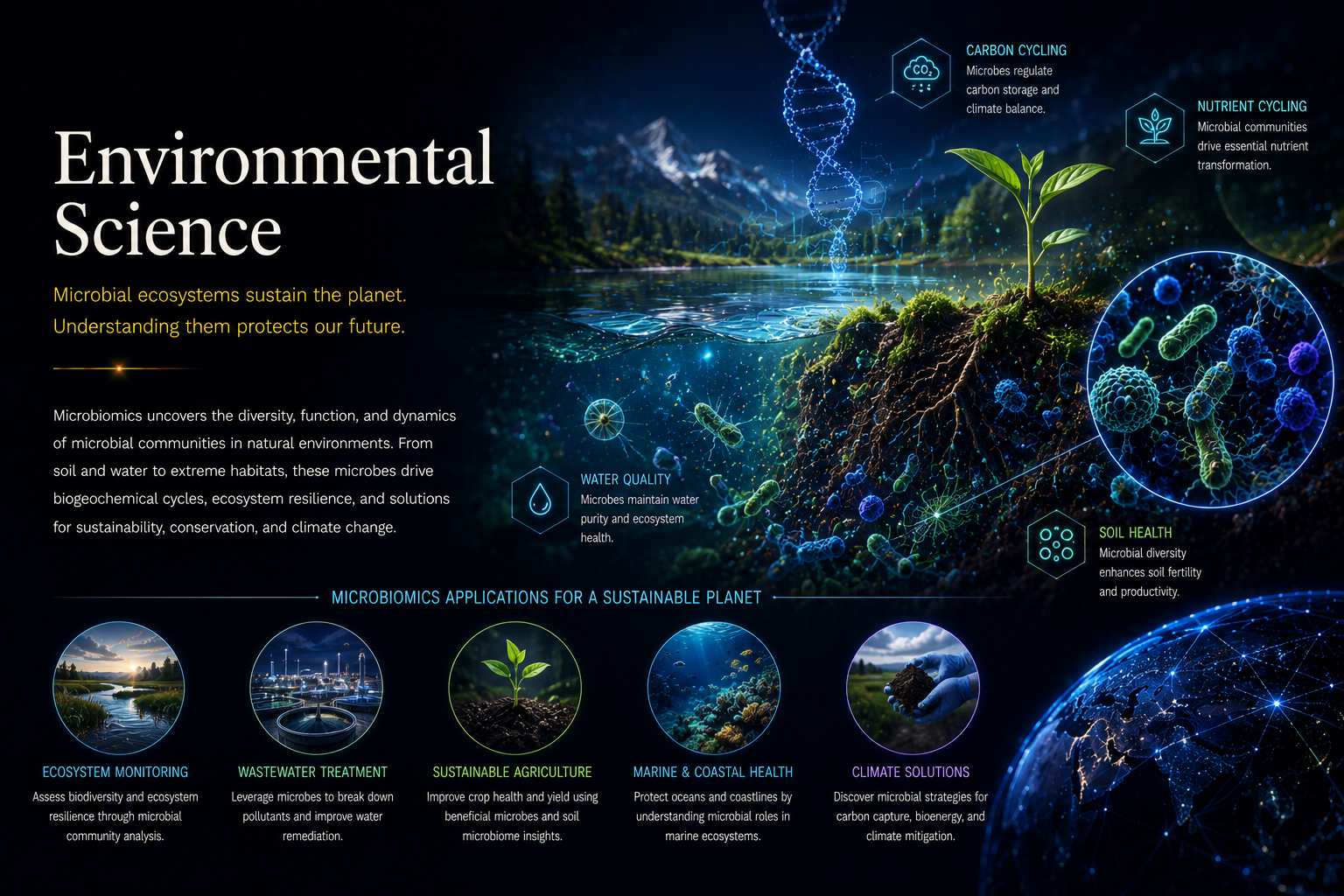
Environmental microbiomics studies microbial communities across soil, water, air, built environments, and ecosystems, revealing how microbes shape environmental health, nutrient cycling, contamination, climate systems, and ecological resilience.
Research Overview
Environmental microbiomics applies sequencing and computational biology to study microbial communities in natural and built environments. These microbial systems influence nutrient cycling, ecosystem stability, water quality, soil health, climate processes, pollution response, and environmental exposure.
At PanorOmics, environmental science is presented as a core microbiomics research area: a bridge between microbial ecology, ecosystem monitoring, environmental health, infectious disease surveillance, antimicrobial resistance, and multi-omics environmental systems biology.
Core Research Areas
Environmental Microbiome Profiling
Studying microbial communities across soil, water, air, built environments, and ecological systems.
Microbial Ecology
Analyzing how microbes interact with each other, their hosts, nutrients, pollutants, and environmental conditions.
Biogeochemical Cycling
Investigating microbial roles in carbon, nitrogen, sulfur, phosphorus, and nutrient cycling across ecosystems.
Environmental Health and Surveillance
Using microbiome data to monitor contamination, ecosystem disruption, antimicrobial resistance, and environmental risk.
Environmental Microbiomics Technologies
16S rRNA Sequencing
Amplicon sequencing used to profile bacterial and archaeal community composition across environmental samples.
Shotgun Metagenomics
Whole-community DNA sequencing used to characterize microbial diversity, functional genes, pathways, and ecological potential.
Metatranscriptomics
RNA-based profiling used to study active microbial gene expression and functional responses in environmental systems.
Environmental DNA Analysis
eDNA methods used to detect organisms and microbial signatures from environmental samples such as soil, water, and sediment.
AI-Assisted Environmental Microbiomics
Computational approaches that support microbial classification, ecosystem pattern discovery, risk prediction, and functional interpretation.
Environmental Microbiomics Modalities
Soil Microbiomics
Studies microbial communities involved in nutrient cycling, plant health, agriculture, and ecosystem stability.
Water Microbiomics
Profiles microbial communities in freshwater, marine, wastewater, and drinking water environments.
Built Environment Microbiomics
Analyzes microbial communities in homes, hospitals, laboratories, schools, transportation systems, and urban spaces.
Pollution and Exposure Microbiomics
Studies how pollutants, chemicals, climate stressors, and environmental exposures alter microbial communities.
Antimicrobial Resistance Surveillance
Uses microbiome and metagenomic data to monitor resistance genes across environmental reservoirs.
Ecosystem Microbiome Monitoring
Tracks microbial community changes over time to assess environmental health, biodiversity, and ecological disturbance.
Related microbiomic approaches such as human health, precision medicine, and infectious disease microbiomics are explored across the Microbiomics Research Center.
Landmark Environmental Microbiomics Milestones
Environmental Microbial Ecology
Environmental microbiology established microbes as essential drivers of ecosystem function, nutrient cycling, and environmental health.
Molecular Microbial Ecology
DNA-based methods expanded environmental microbiology beyond culture-based analysis toward community-level microbial profiling.
Environmental Metagenomics
Shotgun metagenomics enabled direct study of microbial communities, functional genes, and ecological pathways from environmental samples.
Environmental DNA and Ecosystem Monitoring
eDNA approaches expanded microbial and biodiversity surveillance across water, soil, sediment, and ecological systems.
Microbiomes and Climate Systems
Environmental microbiomics increasingly connects microbial communities with climate change, carbon cycling, pollution, and ecosystem resilience.
Metagenomic Surveillance
Environmental microbiome data increasingly supports monitoring of pathogens, antimicrobial resistance, contamination, and public health risk.
AI-Assisted Environmental Microbiome Interpretation
AI increasingly supports microbial classification, ecological pattern discovery, functional prediction, environmental surveillance, and ecosystem modeling.
Featured Publications
Metagenomics: Genomic Analysis of Microbial Communities
The Earth Microbiome Project
Environmental DNA for Biodiversity Monitoring
Microbial Ecology and Biogeochemical Cycling
Metagenomic Surveillance of Antimicrobial Resistance
AI and Environmental Microbiome Analysis
Continue Your Research Journey
Human Health →
Continue exploring the Microbiomics Research Center.
Precision Medicine →
Continue exploring the Microbiomics Research Center.
Infectious Diseases →
Continue exploring the Microbiomics Research Center.