Infectious Diseases
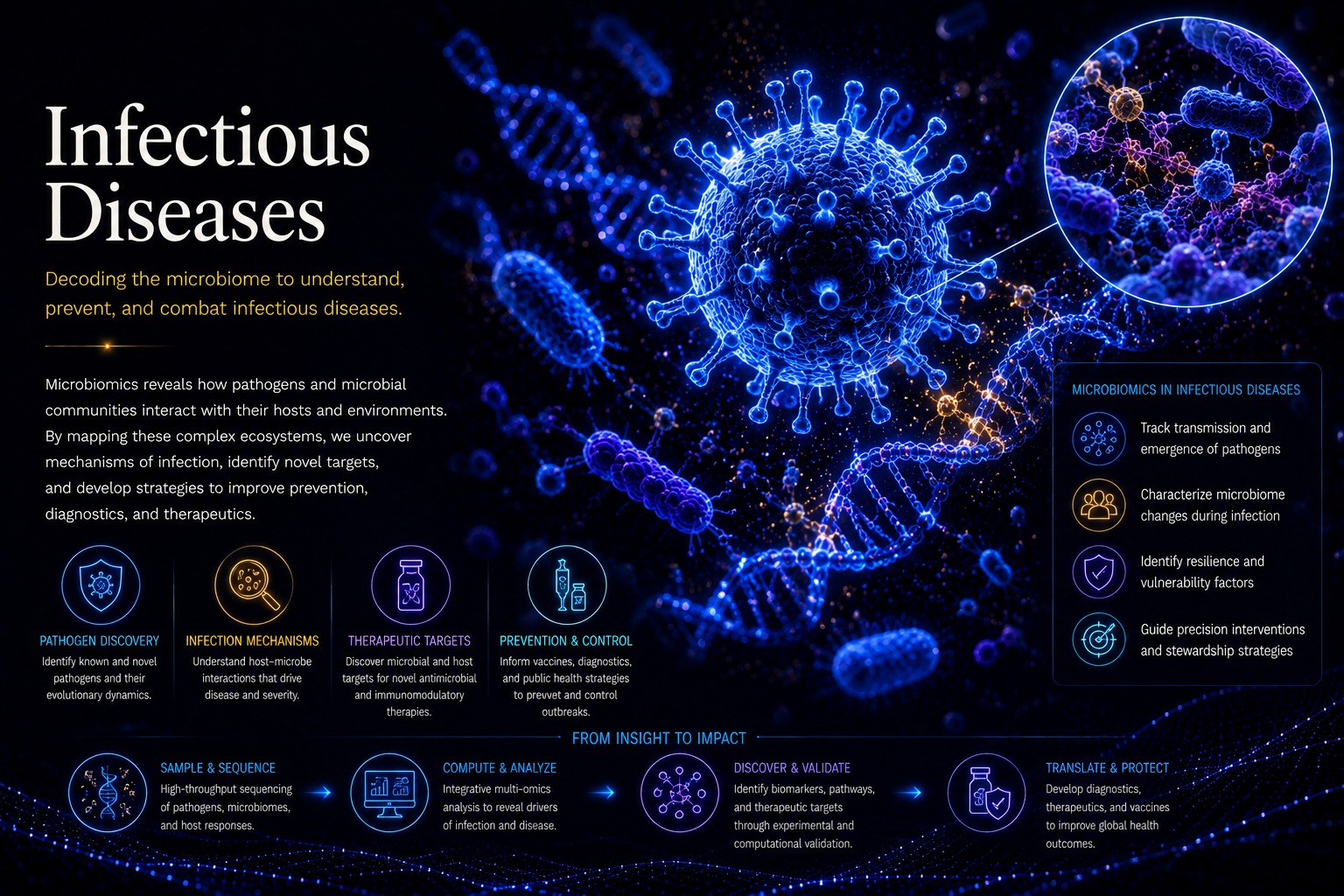
Infectious disease microbiomics studies how microbial communities, pathogens, resistance genes, and host–microbe interactions shape infection risk, immune response, disease severity, and outbreak surveillance.
Research Overview
Infectious disease microbiomics examines how microbial ecosystems influence pathogen colonization, immune defense, antimicrobial resistance, and clinical outcomes. Rather than studying pathogens alone, microbiomics considers the broader community context in which infections emerge, spread, and resolve.
At PanorOmics, infectious diseases are presented as a core microbiomics research area: a bridge between pathogen biology, microbial ecology, host immunity, antimicrobial resistance, outbreak surveillance, and multi-omics infection research.
Core Research Areas
Pathogen–Microbiome Interactions
Studying how microbial communities influence pathogen colonization, infection risk, immune response, and disease severity.
Microbiome and Immune Defense
Analyzing how resident microbes shape mucosal immunity, inflammation, barrier function, and host resistance to infection.
Antimicrobial Resistance
Investigating resistance genes, microbial reservoirs, and community-level patterns that influence treatment failure and public health risk.
Infectious Disease Surveillance
Using microbiome and metagenomic data to monitor pathogens, outbreaks, transmission patterns, and microbial ecosystem disruption.
Infectious Disease Microbiomics Technologies
16S rRNA Sequencing
Amplicon sequencing used to profile microbial community shifts associated with infection, colonization, and dysbiosis.
Shotgun Metagenomics
Whole-community sequencing used to detect pathogens, resistance genes, virulence factors, and functional microbial pathways.
Metatranscriptomics
RNA-based profiling used to study active microbial gene expression during infection and host–pathogen interaction.
Pathogen Genomics
Sequencing-based analysis of pathogen genomes to support strain tracking, transmission analysis, and outbreak investigation.
AI-Assisted Infectious Disease Microbiomics
Computational approaches that support pathogen detection, resistance prediction, outbreak analysis, and microbiome-based risk modeling.
Infectious Disease Microbiomics Modalities
Gut Infection Microbiomics
Studies how gut microbial communities influence gastrointestinal infection, colonization resistance, inflammation, and recovery.
Respiratory Microbiomics
Profiles airway and lung microbial communities involved in respiratory infection, inflammation, and disease susceptibility.
Hospital and Clinical Microbiomics
Analyzes microbial communities in clinical environments, patient samples, and healthcare-associated infection risk.
Antimicrobial Resistance Surveillance
Uses metagenomic data to detect resistance genes and monitor antimicrobial resistance across microbial communities.
Viral–Bacterial Microbiome Interactions
Studies how viral infections alter bacterial communities and how microbiomes influence viral disease outcomes.
Multi-omics Infection Biology
Combines microbiomics with genomics, transcriptomics, proteomics, metabolomics, lipidomics, and immune profiling.
Related microbiomic approaches such as environmental science, human health, and precision medicine microbiomics are explored across the Microbiomics Research Center.
Landmark Infectious Disease Microbiomics Milestones
Germ Theory and Infectious Microbiology
Foundational microbiology established microbes as causes of infectious disease and transformed diagnosis, prevention, and treatment.
Antibiotic Era and Resistance Emergence
Antibiotics transformed infectious disease treatment, while antimicrobial resistance emerged as a major biological and public health challenge.
Molecular Pathogen Detection
DNA-based methods expanded infectious disease research beyond culture-based testing toward molecular detection and microbial community analysis.
Metagenomics in Infectious Disease
Shotgun metagenomics enabled detection of pathogens, resistance genes, virulence factors, and microbial community disruption from complex samples.
Microbiome and Infection Susceptibility
Microbiome research increasingly linked microbial community structure with infection risk, immune defense, dysbiosis, and disease severity.
Genomic and Metagenomic Surveillance
Sequencing-based surveillance increasingly supports outbreak tracking, antimicrobial resistance monitoring, and pathogen transmission analysis.
AI-Assisted Infectious Disease Microbiome Interpretation
AI increasingly supports pathogen detection, resistance prediction, microbiome risk modeling, outbreak surveillance, and infection biology.
Featured Publications
The Human Microbiome Project and Infection Biology
Metagenomic Sequencing for Infectious Disease Diagnosis
Microbiota and Colonization Resistance
Antimicrobial Resistance in Microbial Communities
Pathogen Genomics and Outbreak Surveillance
AI and Infectious Disease Microbiomics
Continue Your Research Journey
Environmental Science →
Continue exploring the Microbiomics Research Center.
Human Health →
Continue exploring the Microbiomics Research Center.
Precision Medicine →
Continue exploring the Microbiomics Research Center.