Biomarker Discovery
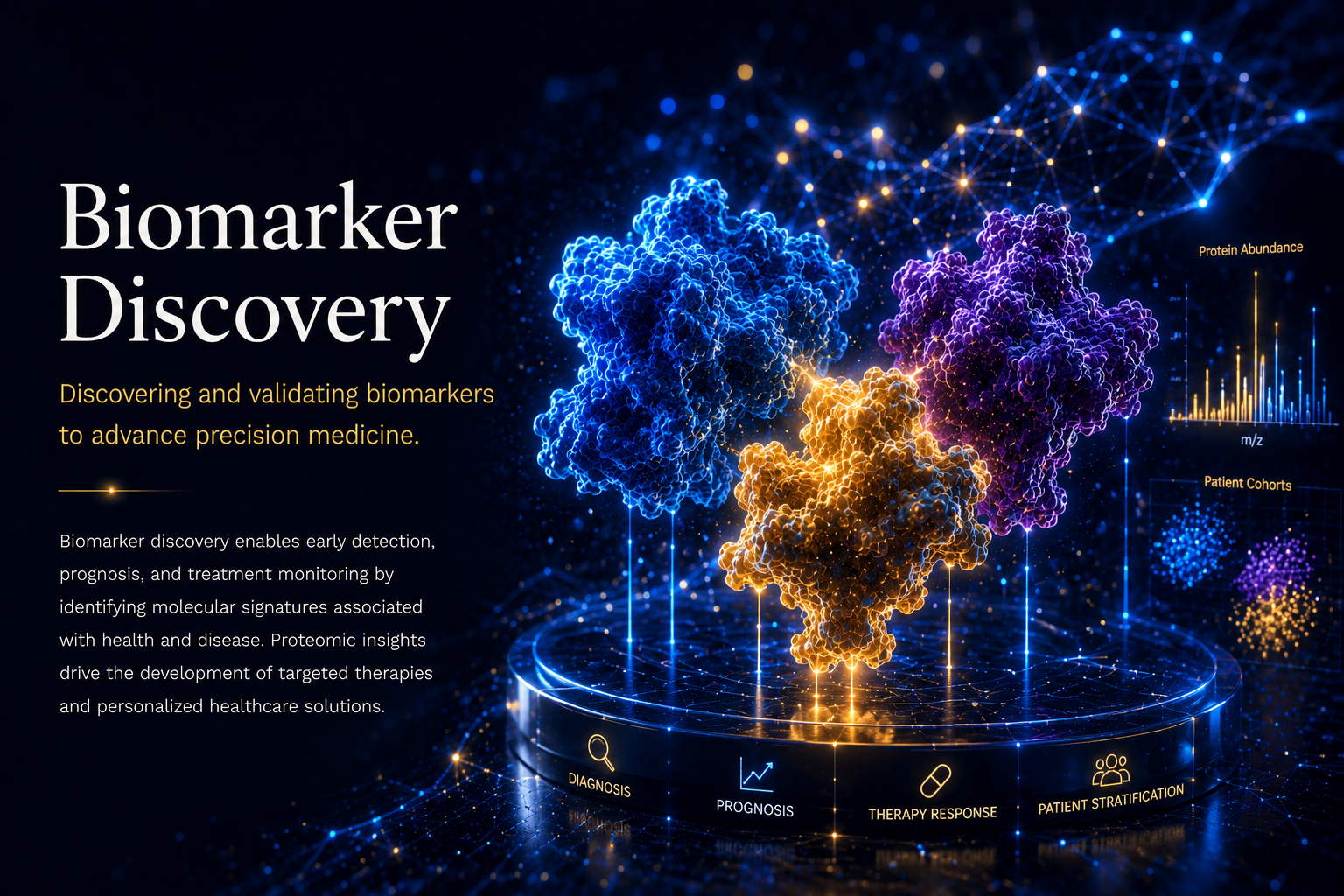
Biomarker discovery uses proteomic analysis to identify measurable protein signatures associated with disease biology, diagnosis, prognosis, therapeutic response, and precision medicine.
Research Overview
Protein biomarkers provide measurable indicators of biological state, disease activity, treatment response, and clinical outcome. Because proteins often reflect active cellular function more directly than DNA or RNA alone, proteomic biomarker discovery plays an important role in translational research and precision medicine.
At PanorOmics, biomarker discovery is presented as a core proteomics research area: a bridge between protein measurement, disease mechanisms, clinical translation, diagnostic development, therapeutic monitoring, and multi-omics interpretation.
Core Research Areas
Protein Biomarker Discovery
Identifying proteins associated with disease presence, progression, treatment response, prognosis, or biological state.
Clinical Proteomics
Applying proteomic technologies to patient samples, translational research, diagnostics, and precision medicine studies.
Disease Signature Analysis
Defining protein expression patterns that distinguish disease subtypes, molecular phenotypes, and therapeutic response groups.
Validation and Translation
Evaluating candidate biomarkers through targeted assays, reproducibility testing, clinical cohorts, and translational workflows.
Biomarker Technologies
Mass Spectrometry
High-resolution protein measurement technology used to discover, quantify, and characterize candidate biomarkers.
Targeted Proteomics
Focused protein quantification approaches such as SRM, MRM, and PRM used to validate candidate biomarkers.
Immunoassays
Antibody-based methods such as ELISA and multiplex assays used for clinical biomarker measurement and validation.
Protein Arrays
High-throughput platforms used to screen protein abundance, immune responses, and biomarker candidates across many samples.
AI-Assisted Proteomics
Computational and machine learning approaches that help identify biomarker signatures, classify disease states, and interpret proteomic data.
Biomarker Modalities
Discovery Proteomics
Broad, unbiased profiling used to identify candidate proteins associated with biological or disease states.
Targeted Biomarker Validation
Focused measurement of selected protein candidates across larger or independent sample cohorts.
Plasma Proteomics
Protein profiling in blood-based samples to discover circulating biomarkers for disease detection and monitoring.
Tissue Proteomics
Proteomic analysis of tissue samples to identify disease-associated protein signatures and molecular mechanisms.
Multi-omics Biomarker Integration
Combines proteomic data with genomics, transcriptomics, metabolomics, and clinical information.
Clinical Translation
Moves candidate biomarkers toward diagnostic, prognostic, predictive, or therapeutic applications.
Related proteomic approaches such as protein identification, mass spectrometry, and protein interaction analysis are explored across the Proteomics Research Center.
Landmark Biomarker Discovery Milestones
Protein Biomarker Foundations
Early clinical protein markers established the concept that measurable proteins can reflect disease presence, progression, or treatment response.
Immunoassay Expansion
ELISA and antibody-based assays expanded targeted protein measurement for clinical testing and biomarker validation.
Proteomics Era Emerges
Large-scale protein profiling accelerated discovery-based approaches for identifying disease-associated protein signatures.
Mass Spectrometry Biomarker Discovery
Mass spectrometry enabled high-resolution discovery and quantification of protein biomarkers across tissues, plasma, and disease cohorts.
Targeted Proteomics Validation
Targeted proteomics strengthened biomarker validation by enabling reproducible measurement of selected proteins across larger sample sets.
Multi-omics Biomarker Integration
Integrated omics approaches connect protein biomarkers with genomic, transcriptomic, metabolic, and clinical data.
AI-Assisted Biomarker Discovery
AI increasingly supports biomarker signature discovery, patient stratification, disease classification, and translational proteomics.
Featured Publications
The Proteome: A New Concept in Protein Analysis
Proteomics in Disease Biomarker Discovery
Mass Spectrometry-Based Proteomics
Targeted Mass Spectrometry for Biomarker Verification
Plasma Proteomics and Disease Biomarkers
Multi-omics Biomarker Discovery
Continue Your Research Journey
Protein Identification →
Continue exploring the Proteomics Research Center.
Mass Spectrometry →
Continue exploring the Proteomics Research Center.
Protein Interactions →
Continue exploring the Proteomics Research Center.