Protein Identification
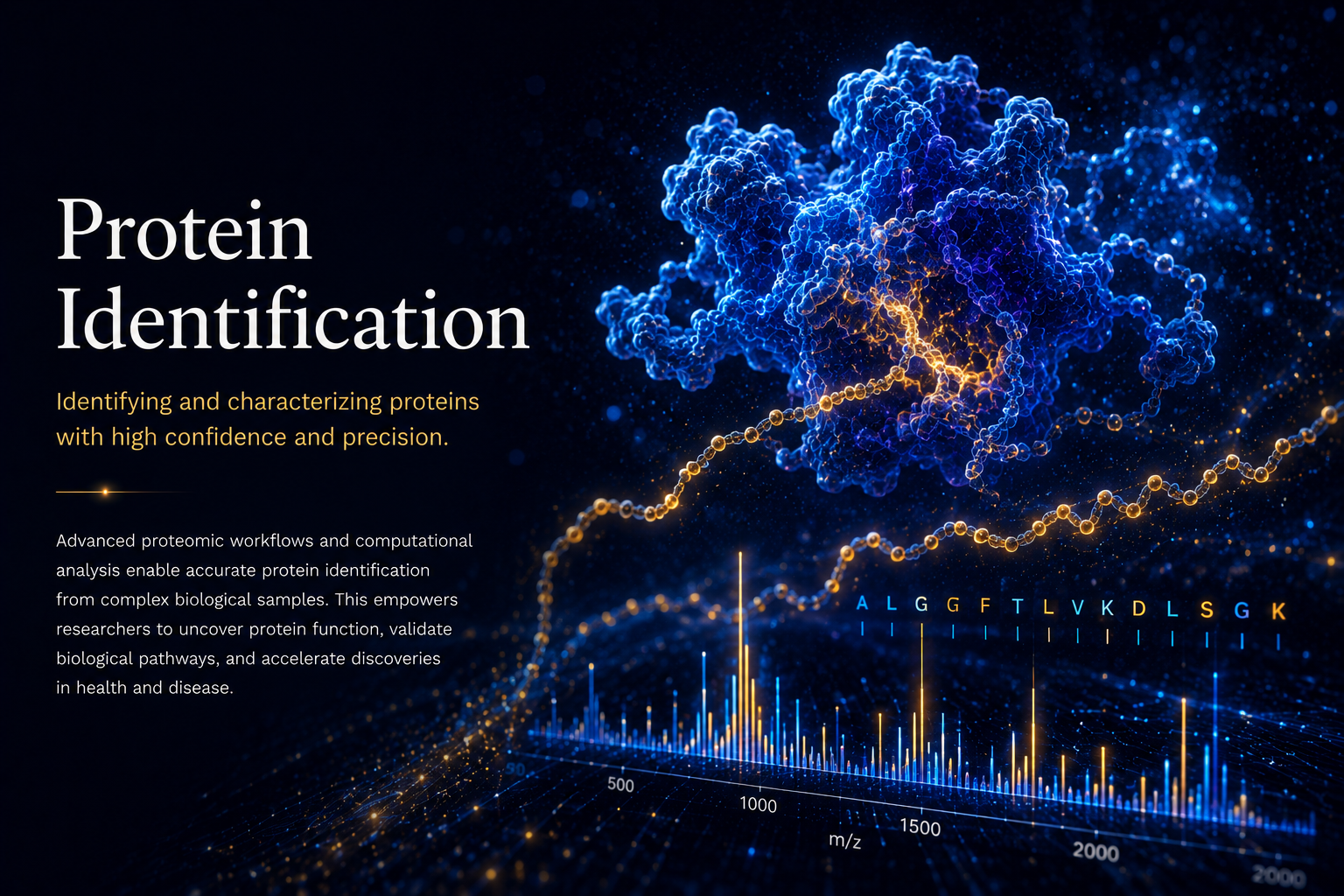
Protein identification determines which proteins are present in biological samples, enabling researchers to characterize proteomes, map pathways, study disease mechanisms, and connect molecular evidence to biological function.
Research Overview
Protein identification is a foundational task in proteomics. By measuring peptides and matching them to protein sequences, researchers can determine which proteins are present in cells, tissues, biological fluids, disease samples, and experimental systems.
At PanorOmics, protein identification is presented as a core proteomics research area: the starting point for proteome characterization, pathway analysis, biomarker discovery, protein interaction studies, and multi-omics interpretation.
Core Research Areas
Protein Discovery
Identifying proteins present in cells, tissues, biological fluids, disease samples, or experimental systems.
Peptide Mapping
Using peptide-level evidence to infer protein identity, sequence coverage, isoforms, and molecular features.
Protein Annotation
Connecting identified proteins to biological function, pathways, cellular localization, disease mechanisms, and molecular networks.
Proteome Characterization
Building comprehensive protein profiles that support systems biology, biomarker discovery, and multi-omics integration.
Protein Identification Technologies
LC-MS/MS
Liquid chromatography tandem mass spectrometry used to separate, fragment, and identify peptides from complex protein mixtures.
MALDI-TOF
Mass spectrometry approach used for rapid protein and peptide mass profiling, microbial identification, and biomolecular analysis.
Database Searching
Computational matching of mass spectra to protein sequence databases to identify peptides and proteins.
De Novo Peptide Sequencing
Inferring peptide sequences directly from fragmentation spectra when database matches are incomplete or unavailable.
AI-Assisted Protein Identification
Machine learning approaches that improve spectral prediction, peptide matching, confidence scoring, and proteome interpretation.
Protein Identification Modalities
Shotgun Proteomics
Unbiased protein identification from complex samples through enzymatic digestion, peptide sequencing, and database matching.
Bottom-up Proteomics
Identifies proteins by analyzing peptides generated from digested protein samples.
Top-down Proteomics
Analyzes intact proteins to preserve information about isoforms, sequence variants, and post-translational modifications.
Targeted Protein Identification
Focuses on predefined proteins or peptides for confirmation, validation, or focused biological questions.
Proteogenomics
Integrates proteomic data with genomic and transcriptomic information to improve protein discovery and annotation.
Clinical Protein Identification
Applies protein identification workflows to disease samples, diagnostics, biomarker discovery, and translational research.
Related proteomic approaches such as mass spectrometry, protein interaction analysis, and biomarker discovery are explored across the Proteomics Research Center.
Landmark Protein Identification Milestones
Protein Sequencing Foundations
Early protein sequencing methods established the principle that proteins could be identified through amino acid sequence information.
Two-Dimensional Gel Electrophoresis
2D gel electrophoresis enabled separation and comparison of complex protein mixtures across biological samples.
Mass Spectrometry for Biomolecules
Soft ionization methods expanded mass spectrometry into protein and peptide analysis.
Database-Driven Protein Identification
Protein sequence databases and search algorithms transformed peptide spectra into scalable protein identification workflows.
Shotgun Proteomics
Shotgun proteomics enabled high-throughput identification of thousands of proteins from complex biological samples.
Proteogenomic Identification
Proteogenomics integrated mass spectrometry with genomic and transcriptomic data to improve protein annotation and discovery.
AI-Assisted Protein Identification
AI increasingly supports spectral prediction, peptide identification, protein inference, and large-scale proteome interpretation.
Featured Publications
The Proteome: A New Concept in Protein Analysis
Proteomics by Mass Spectrometry
Mass Spectrometry-Based Proteomics
Shotgun Proteomics
Proteogenomics
Deep Learning for Protein Identification
Continue Your Research Journey
Mass Spectrometry →
Continue exploring the Proteomics Research Center.
Protein Interactions →
Continue exploring the Proteomics Research Center.
Biomarker Discovery →
Continue exploring the Proteomics Research Center.