Mass Spectrometry
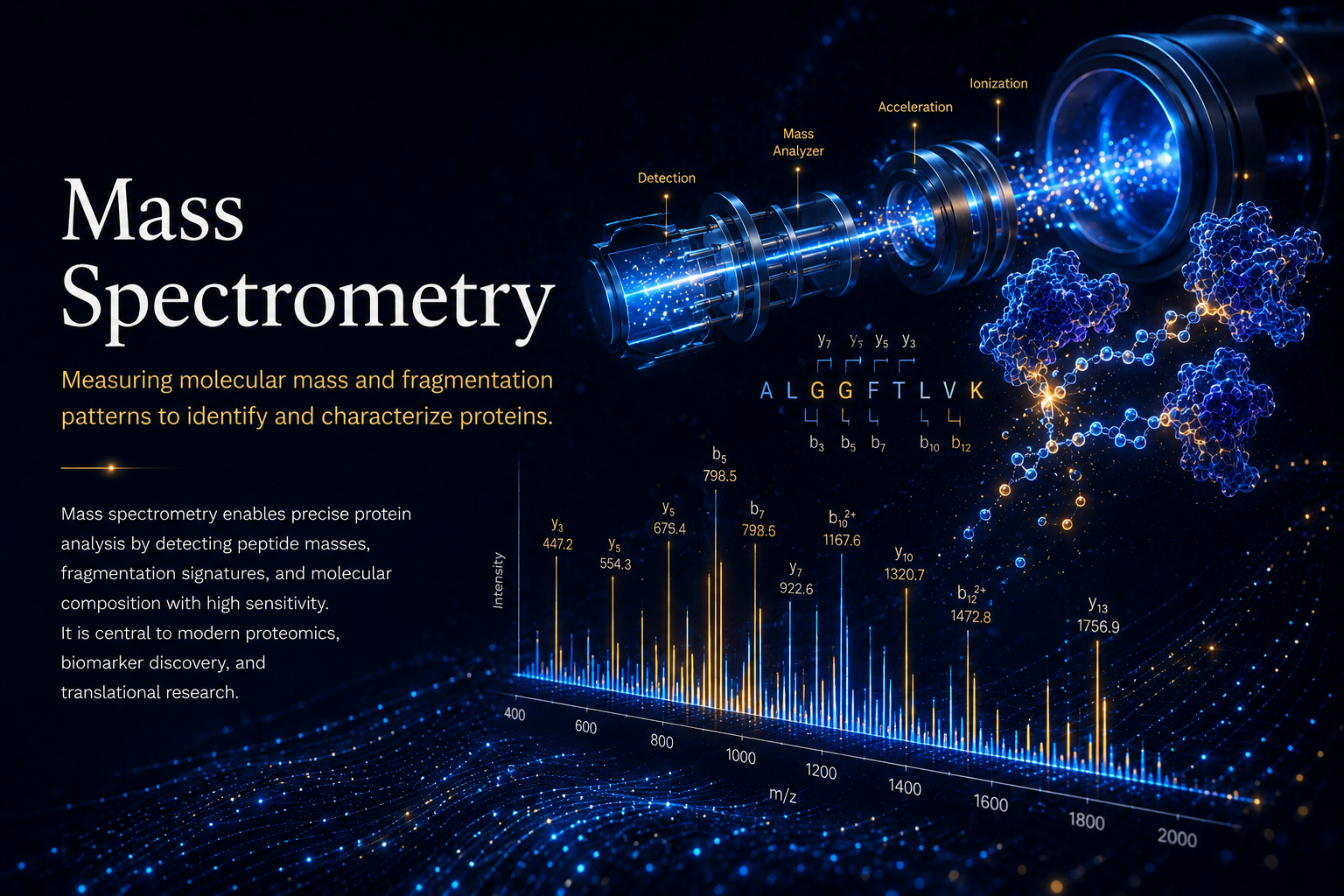
Mass spectrometry measures molecules by mass-to-charge ratio, enabling high-resolution protein identification, quantification, post-translational modification analysis, biomarker discovery, and systems-level proteomics.
Research Overview
Mass spectrometry is one of the central technologies of modern proteomics. By converting molecules into ions and measuring their mass-to-charge patterns, researchers can identify proteins, quantify peptide abundance, detect post-translational modifications, and compare molecular signatures across biological and clinical samples.
At PanorOmics, mass spectrometry is presented as a core proteomics research technology: a bridge between protein measurement, pathway activity, biomarker discovery, clinical translation, and multi-omics interpretation.
Core Research Areas
Protein Quantification
Measuring protein abundance across samples, tissues, disease states, treatments, and biological conditions.
Peptide and Protein Identification
Identifying proteins by measuring peptide mass, fragmentation patterns, and sequence-informative spectra.
Post-translational Modification Analysis
Detecting protein modifications such as phosphorylation, acetylation, ubiquitination, glycosylation, and methylation.
Clinical Mass Spectrometry
Applying mass spectrometry to translational research, biomarker discovery, diagnostics, and precision medicine studies.
Mass Spectrometry Technologies
LC-MS/MS
Liquid chromatography coupled with tandem mass spectrometry for high-resolution peptide and protein analysis.
MALDI-TOF
Matrix-assisted laser desorption ionization time-of-flight mass spectrometry used for rapid mass measurement and protein profiling.
Orbitrap Mass Spectrometry
High-resolution mass analysis widely used in modern proteomics for accurate peptide identification and quantification.
Time-of-Flight Mass Spectrometry
Mass analysis based on ion flight time, used in proteomics, metabolomics, clinical testing, and biomolecular profiling.
Targeted Mass Spectrometry
Focused approaches such as SRM, MRM, and PRM used to measure selected proteins or peptides with high reproducibility.
Mass Spectrometry Modalities
Discovery Proteomics
Unbiased mass spectrometry profiling used to identify proteins and molecular signatures across biological samples.
Targeted Proteomics
Focused measurement of predefined proteins or peptides for validation, quantification, and translational studies.
Label-free Quantification
Compares protein abundance across samples without chemical or isotopic labeling.
Isobaric Labeling
Uses labeling strategies such as TMT or iTRAQ to compare multiple samples in multiplexed proteomics experiments.
Phosphoproteomics
Measures phosphorylation events to study signaling pathways, kinase activity, and disease-associated regulation.
Proteogenomics
Integrates mass spectrometry data with genomic and transcriptomic information to improve protein annotation and discovery.
Related proteomic approaches such as protein identification, protein interaction analysis, and biomarker discovery are explored across the Proteomics Research Center.
Landmark Mass Spectrometry Milestones
Mass Spectrometry Foundations
Early mass spectrometry established the principle of separating ions by mass-to-charge ratio.
Soft Ionization Methods
Ionization advances made it possible to analyze larger biomolecules, helping move mass spectrometry toward biological research.
Proteomics Mass Spectrometry
Mass spectrometry became central to large-scale protein identification, peptide sequencing, and proteome analysis.
LC-MS/MS Proteomics
Liquid chromatography tandem mass spectrometry enabled high-throughput protein identification and quantitative proteomics.
Targeted and Quantitative Proteomics
Targeted mass spectrometry strengthened reproducible protein measurement for biomarker validation and translational studies.
Single-cell and Ultra-sensitive Proteomics
Improved instrumentation and workflows expanded proteomics toward lower-input samples, rare cell populations, and single-cell analysis.
AI-Assisted Mass Spectrometry
AI increasingly supports spectral interpretation, peptide identification, protein quantification, and proteomic signature discovery.
Featured Publications
Mass Spectrometry-Based Proteomics
Proteomics by Mass Spectrometry
The Proteome: A New Concept in Protein Analysis
Quantitative Proteomics Using Mass Spectrometry
Targeted Mass Spectrometry for Proteomics
Deep Learning for Proteomics and Mass Spectrometry
Continue Your Research Journey
Protein Identification →
Continue exploring the Proteomics Research Center.
Protein Interactions →
Continue exploring the Proteomics Research Center.
Biomarker Discovery →
Continue exploring the Proteomics Research Center.