Protein Interactions
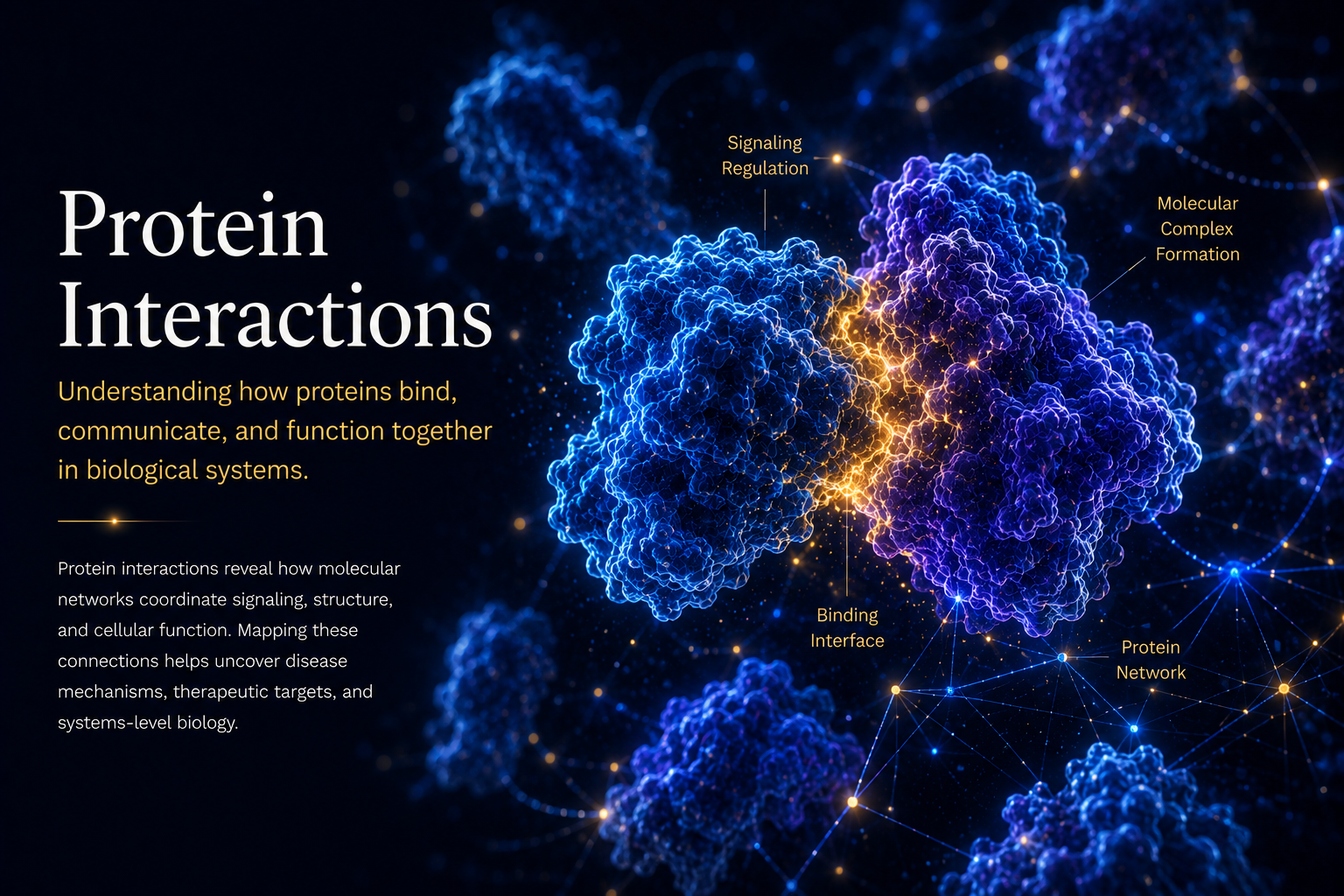
Protein interaction research maps how proteins associate, form complexes, transmit signals, regulate pathways, and organize cellular systems across health, disease, and therapeutic response.
Research Overview
Protein interactions are essential for cellular function because proteins rarely act alone. They assemble into complexes, regulate signaling pathways, control gene expression, coordinate metabolism, and shape the molecular networks that sustain life.
At PanorOmics, protein interactions are presented as a core proteomics research area: a systems-level framework for understanding pathway organization, disease mechanisms, biomarker discovery, therapeutic targeting, and multi-omics network biology.
Core Research Areas
Protein–Protein Interaction Mapping
Identifying physical and functional interactions among proteins to understand molecular complexes, signaling pathways, and cellular organization.
Pathway and Network Biology
Studying how interacting proteins form biological networks that regulate cellular processes, disease mechanisms, and therapeutic response.
Protein Complex Analysis
Characterizing multi-protein assemblies that coordinate transcription, metabolism, signaling, DNA repair, and cellular structure.
Disease Interaction Networks
Analyzing disrupted protein interaction networks associated with cancer, neurodegeneration, immune disease, infection, and therapeutic resistance.
Protein Interaction Technologies
Affinity Purification Mass Spectrometry
Combines protein enrichment with mass spectrometry to identify interacting partners and protein complexes.
Yeast Two-Hybrid Screening
Detects direct protein–protein interactions using genetic reporter systems.
Co-immunoprecipitation
Experimental method used to test whether proteins associate within biological samples.
Proximity Labeling
Approaches such as BioID and APEX label nearby proteins to map interaction environments in living cells.
Computational Interaction Prediction
AI and network-based methods used to predict protein interactions, complexes, and functional relationships.
Protein Interaction Modalities
Physical Protein Interactions
Direct or indirect molecular associations between proteins within cells or biological systems.
Protein Complexes
Groups of proteins that assemble into functional molecular machines.
Signaling Networks
Protein interaction pathways that transmit biological signals and regulate cellular responses.
Disease Network Analysis
Mapping altered protein interactions that contribute to disease mechanisms and therapeutic resistance.
Interactome Mapping
Large-scale mapping of protein interaction networks across cells, tissues, organisms, or disease states.
Multi-omics Network Integration
Combines protein interaction data with genomics, transcriptomics, proteomics, metabolomics, and clinical data.
Related proteomic approaches such as protein identification, mass spectrometry, and biomarker discovery are explored across the Proteomics Research Center.
Landmark Protein Interaction Milestones
Protein Interaction Assays
Experimental approaches such as co-immunoprecipitation and yeast two-hybrid screening helped establish systematic protein interaction analysis.
Interactome Mapping
Large-scale studies began mapping protein interaction networks across organisms and biological systems.
Affinity Purification Mass Spectrometry
AP-MS enabled high-throughput identification of protein complexes and interaction partners in biological samples.
Network Biology
Protein interaction data became central to pathway analysis, systems biology, disease network modeling, and functional interpretation.
Proximity Labeling
BioID, APEX, and related methods expanded interaction mapping by capturing protein neighborhoods inside living cells.
Disease Interactomics
Protein interaction networks increasingly support research into cancer, neurodegeneration, immune disease, infection, and drug response.
AI-Assisted Interaction Prediction
AI increasingly supports protein interaction prediction, complex modeling, network interpretation, and therapeutic target discovery.
Featured Publications
Two-Hybrid System for Protein Interaction Discovery
A Comprehensive Analysis of Protein–Protein Interactions in Saccharomyces cerevisiae
A Protein Interaction Map of Drosophila melanogaster
Proteomic Analysis of Human Protein Complexes
Proximity-Dependent Biotin Identification
AI-Based Protein Structure and Interaction Modeling
Continue Your Research Journey
Protein Identification →
Continue exploring the Proteomics Research Center.
Mass Spectrometry →
Continue exploring the Proteomics Research Center.
Biomarker Discovery →
Continue exploring the Proteomics Research Center.